Saturday, October 25, 2008

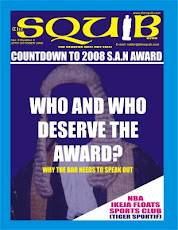
COUNTDOWN TO 2008 SAN AWARD: MATTERS ARISING


On 14th October 2008 the Supreme Court of Nigeria, invited 57 lawyers to attend an interview on 30th October, 2008 to determine their final eligibility for the award of the rank of Senior Advocate of Nigeria. The fifty seven invitees are:
1. Kola Babalola
2. Emonema B. Ukiri
3. Nella E. Andem-Ewe
4. Henry O. Ogbodu
5. Fredinand Orbih
6. Dan Ose Okoh
7. Arthur Obi Okafor
8. Charles Ajuyah
9. Nelson Ajuzie uzuegbu
10. Karina Tunyan
11. Oguneso Rotimi Oluseyi
12. Olabisi Oluyemi Soyebo
13. Abubakar Malami
14. Lawal Rabbana Rafiu Adeyanju
15. Eyitayo Jegede
16. Kehinde Kolawole Eleja
17. Joy Okungbowa Adesina
18. Suleiman Abdulkadir
19. Prince Orji Nwafor Orizu
20. Anthony Aondoakaa Ijohor
21. Ikechukwu Ezechukwu
22. Adetokunbo Omorogie Okeaya –Inneh
23. Mike Agedor Abu Ozekhome
24. Cyrill Oluwafeyisetan Toyin Pinheiro
25. Falana Obafemi Patrick
26. Olusina Rafiu Sofola
27. Ogunde Oluwemimo Adepoju Revell
28. Clement O. I. Okwusogu
29. Oyesoji Gbolahan Oyeleke
30. Dr. Abiodun Ishola Ismail Layonu
31. Oluseye Samuel Opasanya
32. Sagay Omatsoguwa Mogbeyi
33. Babajide Olatokunbo Koku
34. Fagbohunlu John Babatunde
35. Dr. Joseph Agburuwhua Nwobike
36. Ogunba Adekunle Babatunde
37. Obatosin Ogunkeye
38. Etigwe Uwa
39. Andrew Osaro Eghobamien
40. Norrison Ibinabo Quakers
41. Daramola Lucas Olu
42. Rotimi Jacobs
43. Oladipo Aigbedo Okpeseyi
44. Theophilus Kolawole Esan
45. Adebayo Adeleke Lawal
46. Alhaji Olasunkanmi Alimi Sanusi
47. Akinbiyi Oluseun Tayo
48. Ayoola Olufemi Ajayi
49. Chiesonu Igbojamuike Okpoko
50. Lawal Mohammed Pedro
51. Olumide Sofowora
52. Donald Chika Denwigwe
53. Francis Chukwumaeze Dike
54. Ulasi Raleke Obiefuma
55. Njemanze Ken Chukwuma Ohir
56. Eze Duru-Iheoma
57. Ephraim Thomson Onyewuchi Njoku
The invitation interestingly enough was made public via newspaper advertisement (The Guardian) on Tuesday October 14 2008. Even more interesting is the invitation to the members of the General Public to feel free to comment on the “INTEGRITY AND COMPETENCE” of the invitees and send same to one Usman Alhaji Musala, simply described as “Secretary” (one presumes Musala is the Secretary of the Privileges Committee). Below is the reaction of the Squib to the advertisement.


1st Gossip: Praise God, Nigeria is getting better. Honestly things are changing for the better.
2nd Gossip: I am not too sure about that. Well, why did you say that?
1st Gossip: (Pushing page 88 of the Guardian Newspaper of October 14 2008 into 2nd Gossip’s hand) Read this advertisement.
2nd Gossip: (with a snort). But I have seen it already. Invitation for Senior Advocate Interview. What’s the big deal there?
1st Gossip: There is plenty o! In the past you don’t even know anything about the selection process. Those days, it was the more you look, the less you see. The process was near abracadabra. One day you just woke up and saw that Lagbaja, Tamedo and Lakasegbe had become silk!
2nd Gossip: (Sneeringly). But now you are well informed eh?
1st Gossip: At least better that was the case in the past. Now these short-listed candidates we know them, and they are even asking for our comments on them. Lest I forget, some of them are even activists, radicals, progressives. In the old days they would not touch any radical with a long pole.
2nd Gossip: (Even more sneeringly). And who are these your radicals and progressives?
1st Gossip: Femi Falana and Mike Ozekhome
2nd Gossip: Is Patrick a radical. Is Abu a progressive?
1st Gossip: Who is Patrick, and who is Abu?
2nd Gossip: Look you! So you don’t know that Femi Falana is actually Patrick and Mike Ozekhome has a Muslim name of Abu, Abu Olododo? As far as I am concerned they are no radicals.
1st Gossip: (genuinely alarmed). What? Falana is not a radical, Ozekhome is not a progressive? Such prominent human right activists are not radicals? Then what are they?
2nd Gossip: Smart Nigerians who have become wealthy through the cultivated and calculated practice of eye-catching, safe, social and socialising agitations.
1st Gossip: (dumbfounded) Ah! Ah!
2nd Gossip: Stop pretending my friend. Was it not last week that you appeared on LTV and joined two others to berate “so called human rights activists?
1st Gossip: But did I mention Falana? Did I talk about Ozekhome?
2nd Gossip: Leave matter! Mind you, I have not said they are not good or competent lawyers. What I don’t want to hear is this radical stuff.
1st Gossip: It is only God who can save you! But do you agree it is a good thing that the invitation is made public and the public invited to send comments to the committee. To me, the committee is telling the Nigerian public to be part of the selection process of would be-silks.
2nd Gossip: I guess the term “Public” include members of the legal profession, advocates particularly.
1st Gossip: Yes you are right.
2nd Gossip: Do you think members of the Nigerian Bar are that alive to their social responsibility? Many lawyers are no different from the average Nigerian who has little or no time for public affairs and good. We see evil all around us, but we keep mum. We hear reports of evil, we keep mum. We only talk when evil is visited directly on us.
1st Gossip: But are lawyers like that too?
2nd Gossip: Very much so. In the profession, there is a lot of jankara and jibiti going on, but we keep quiet especially if the pepetrator are senior, elderly lawyers. We know of criminally stupid and stupidly criminal judges, but we look the other way. Nobody wants to rock the boat even though the boat is sinking rapidly.
Even now, how many petitions do you think the Privileges – Committee will receive from the bar against these applicants. Pretty little. Could it be that all of these short-listed candidates are free of valid and tangible indictments?
Yet we own the profession and the general public that responsibility, to speak out against evil and evil doers, so that misfits will not be promoted and glorified, undeservingly.
1st Gossip: But when they said people should send their comments on the candidates’ integrity and competence, it doesn’t mean the comments should only be negative. It can be positive
2nd Gossip: I agree absolutely. The only problem is that I won’t put it pass a smart applicant to hire a band of emergency supporters to flood the committee with flattering praises and recommendation.
1st Gossip: Oh what a cynic you are?
2nd Gossip: I have no apology for that. This is Nigeria. Things hardly are what they silk to be. Don’t you know that this SAN award thing is a project and only those who tackle it as such gets it.
1st Gossip: Project? Project ke?
2nd Gossip: Oh yes, it is a project. Let me tell you some of the steps to take if you are serious about getting the silk.
1st Gossip: (taut with interest) I am all ears.
2nd Gossip: First, beg, borrow or safely steal seven to ten million naira. Then remove your chambers from the “manage-manage” quarters you’ve always been, to a big five bedroom bungalow, or a duplex in a neat, high-brow area. Take at least a three-year, before the third year runs out, you should have become a SAN. That will set you back with about three or four million naira. Thirdly, establish an impressive looking library. With about two or three million naira you should quite a collection of law texts, reports and journals.
Of course another million or two naira will take care of office equipment and furniture. Then ensure you employ at least five well behaved (docile more like it) juniors, who you know have no hert, or nerve or commonsense to undermine your application by the disclosure of certain smelly chambers’ matters and affairs.
Please set down about a million naira to upgrade your wardrobe. A would be silk should not share appearances with wretches. Of course you will need at least one impressive looking car, preferably an armed robbery inducing - Jeep, not the types that resemble towing vans. Of course you should have enough change left to cover at least three year applications (just N200,00:00 per application).
Of course, I assume that by all means necessary, you have the requisite number of briefs in the Superior Courts, and the last but not the least, you possess at least one truly influential MENTOR to ease your way through and knock off obstacles from your path.
And, one more thing. Yes, one more thing. While you are applying for silk, don’t ever get cross with judges, no matter how odious they are. You just be a sweet banana and a cool cucumber. You know your humility is only for a time. The time will come, that you, with your silk firmly under your belt will become a cock of the bar.
1st Gossip: Are you saying all the 57 invitees have taken these steps you mentioned.
2nd Gossip: I cannot say. And, none of them consulted me.
1st Gossip: You that have accused the bar of failing to speak out on issues when necessary, let’s hear your views about these invitees.
2nd Gossip: I object. First I don’t know all of them, in fact I only know a few of them. Then secondly my views, if any are to be sent to the Privileges Committee and not to you.
1st Gossip: Comment on the ones you know and those your comments I can send or forward to the Supreme Court.
2nd Gossip: Very well then. I only know Falana, Ozekhome, Lawal Pedro and Jacobs Rotimi, though he likes to call himself Rotimi Jacobs.
1st Gossip: What about them.
2nd Gossip: Brother Patrick (Femi Falana) is somebody I know very well in the bar; not in the court-room. Very intelligent and an arresting orator. As an activist he is controversial. Some respect, even rever him others deride and dismiss him. But nobody denies his influence. Ogunde Oluwawemimo, I know him more in the court than in the bar. Won’t call him a bar man. He has to change that. But as a lawyer, the man is sure good-meticulous, keenly intelligent, very good delivery. If he were a boxer, I’ll liken him to a Mohammed Ali or a Sugar Ray Leonard. One day in court, he so dazzled one of our more obdurate but less perspicacious Judges of the Lagos State Court that the judge exclaimed in utter bewilderment.
“Mr. Ogunde law! Law! Law, law” Law! Law!” (in the manner of saying must you be full of so much law?) Lawal Pedro, is another good advocate. Very good and has been for at least almost a decade now, the life-wire of the Directorate of Civil Prosecutions in the Ministry of Justice Lagos State where is now the Solicitor General. But one wonders why he was never made a judge in Lagos State all these years despite his interest in the bench then? I’ll like to classify Mike Ozekhome and Jacobs Rotimi in the same league. Whatever they may lack in cerebral elegance and sophistication, they more than make up for by sheer rigour of application and bravura. Theirs is the “whirlwind” approach, and both are graduates of the Chief Gani Fawehinmi Chamber. If they were boxers, they would be a Tyson. I know also Norrison Quakers, but more socially than professionally. He dresses and smells already like a Senior Advocate. I also know Adetokubo Okeaya –Inneh, rather from a distance. But I know Chief G.O.K Ajayi SAN has a good view of his abilities as a lawyer. And, that is something. As for Emonena Blessing Ukiri (Port-Harcourt) and Kehinde Eleja, (Ilorin) I know them only in the bar, not in the court. Nice guys enough although Ukiri has weathered more storms of bar politics than Eleja.
1st Gossip: Well you’ve tried. Your opinions may not be shared by everybody though.
2nd Gossip: Of course. I only speak from my own perspective. Now let us have your own views. You too must know some of the candidates
1st Gossip: (Suddenly in a haste to go away) Ah, let that wait for another day. You see I had to go and pick my son from the school. My wife is out of town.
2nd Gossip: (Sneering) I hear you!

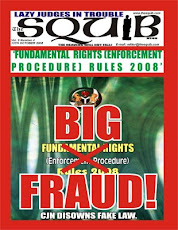
'NOT MY DEED! CHIEF JUSTICE DISOWNS 'FUNDAMENTAL RIGHTS (ENFORCEMENT PROCEDURE) RULES 2008


Considering the extreme range of the criminality of the minds of some Nigerians, one may be naïve to think that one has seen it all, in the antics of felons, and holding that “there is nothing new again under the heavens”
One very common way criminals in the country exhibit their anti-social behaviour is by passing off fake items as genuine. Thus we have lots of fake drugs, fake motor spare parts, fake certificates, fake naira notes, as for the professions may be with the exception of prostitution non is exempt from the staining infection of quackery.
Unfortunately a new and quite disturbing dimension has been introduced into the phenomenon of fakery and its first younger sibling, forgery-the publication and sale of non-existing laws. In the run-up to the August 2008 General Elections of the Nigerian Bar Associates, Ikeazor Akaraiwe, Esq, a 1st Vice-Presidential candidate granted an interview to the “The Nation” newspaper where he made reference to a certain Fundamental Rights (Enforcement Procedure) Rules 2008.
That was about the first time a mention of the so called law would be mentioned in the media. For quite some time now the need for a change or at least an improvement on the Fundamental Rights (Enforcement Procedure) Rules 1979 has been canvassed by concerned lawyers, particularly those with bias for human rights enforcement practice. The general complaint is that the 1979 Rules has certain strictures that makes the practice of the Human Rights Enforcement law, unnecessarily technical and as such on occasion serve to defeat the very essence of its creation-to protect and enhance the fundamental rights and freedoms of the Nigerian citizen.
The office of the creator of the 1979 Rules is the Chief Justice of Nigeria and it is to this honourable office that concerned human right groups, and also the Nigerian bar Association forward draft copies of proposed amendments of the 1979 Rules, for the obvious purpose of serving as reference and resource-materials for his lordship the Honourable Chief Justice of Nigeria in the making of a new Fundamental Rights Enforcement Procedure Rules.
The widespread belief that a new and more liberal Fundamental Rights (Enforcement Procedure) Rules 2008 is in the pipeline, is what some fraudsters (face-less for now) latched on the make a killing.
Every year the General Conference of the Nigerian Bar Association (dubbed the largest gathering of lawyers any where in the world) attracts hundreds, if not thousands of law book sellers. The 2008 conference was no exception. Sellers of law texts and materials swamped the International Conference Centre Abuja Venue of the conference with thousands of their “wares”.
One of such ‘wares’ is the Fundamental Rights (Enforcement Procedure) Rules 2008. The ware came out in two forms, paper back and hard cover editions. The paper back sold and still sells for #500.00 per copy while the hard-cover sold for #1,000.00 a piece.
Sales were snappy as the 2008 FR Rules, being much awaited sold like hot cake. It was not only lawyers who purchased the ‘law’, judges too. By September 2008 lawyers and judges have started making references to the new Rules, which many commended for the liberalization of the procedure of enforcing the Fundamental Rights of people in the country.
In fact only last week, the Squib in our vol. 9 no 3 edition published an 8 page critique a well-thought out appraisal of the Rules, by Lagos lawyer Adejare Kembi esq. Alas, all those who had spent their money to purchase the 2008 F.R Rules, had unwittingly bought a lie. Likewise the efforts of Adejare Kembi author of the critique of the 2008 F.R Rules, which took him three days of steady application is so much a waste of time. The reason is simple-The so called Fundamental Rights (Enforcement Procedure) Rules 2008 is a mere fabrication, even conjuration of some mischevious fraudulent individuals. The so called law, indeed and in fact, is no law at all but a bogus caricature.
This fact was confirmed by Mr. Masade, the Chief Registrar of the Supreme Court of Nigeria in the evening of Wednesday 8th October 2008 via a telephone chat with the editor-in-chief of the Squib. Hear Masade:- “The so called Fundamental Rights (Enforcement Procedure) Rules 2008 law is no law at all. It is the handiwork of some people, who brought the book to sell at the NBA Conference. I am confirming to you that the Chief Justice of Nigeria does not know about the Rules and the Chief Justice did not make those Rules.
You see the NBA has sent a proposed amendment draft of the Rules to the CJN. So when we saw this, the CJN was upset because he thought the NBA had jumped the gun by publishing their proposal and passing of same as the new law. But when we compared what they gave us and the one sold at the NBA conference we found that they were different”.
About a month earlier, one legal practitioner who upon contact with the fake Fundamental Right law suspected its spuriousness, forwarded a letter of complaint to the Chief Justice of Nigeria, requesting for a withdrawal of the illegal Rules (see cover story Exhibit 1).
That lawyer is Femi Falana, the well known human rights activists and author. In a chat with the Squib on Monday the 6th October 2008, Falana explained why he had to write the Chief Justice of Nigeria.
“Before the conference, I had heard about a new 2008 Fundamental Rights (Enforcement Procedure) Rules 2008 being in circulation. A particular candidate in the NBA elections even made reference to it in a Newspaper interview. So when we got to the conference and saw copies of the law, I bought four copies. And other lawyers bought too. Of course I needed to buy and study the ‘new law’ because some of our colleagues were already calling for a review of my book (Fundamental Rights Enforcement) since it examines and discusses the 1979 rules.
However when I read the so called new law, the language of expression was too inelegant. I knew immediately that it could never have issued from the office of the Chief Justice of Nigeria. I then went to the Supreme Court and met with the Chief Registrar who confirmed my fears. I later wrote the Chief Justice.
Falana’s letter did not go-unanswered. The reply was dated 25th September 2008 and signed by One A.G Sambo, Special Assistant to the Hon. Chief Justice of Nigeria. (see cover story exhibit 2). The content was in line with the position of the Chief Registrar, that the law in question was a fake.
Unfortunately it would appear that the authorities have not done enough to sensitive the public about the existence of the fake law. Although Chief Registrar Masade claimed to the Squib that the disclaimers against the fake law have been put in the print and electronic media, it is doubtful whether any appreciable number of lawyers have come across such.
According to a revered figure in the legal profession, Chief G.O.K Ajayi S.A.N, that such a sordid fraud could be perpetrated on the Bar and Bench in Nigeria, is to blamed on the corruption and maladministration of government.
Explaining further the Chief said, “In the past you get your laws, gazettes from the Government press. But then suddenly those who worked there began to hide away the copies. They rather made photocopies of a single one which they sell to people. That has been the culture now for many years at the Government press and the Ministry of Information”.

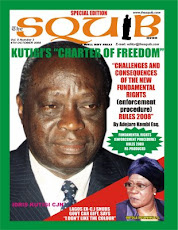
NEW FUNDAMENTAL RIGHTS [ENFORCEMENT PROCEDURE] RULES 2008. A REVOLUTION. By Adejare Kembi

INTRODUCTION

THE NEW FUNDAMENTAL RIGHTS [ENFORCEMENT PROCEDURE] RULES 2008. A REVOLUTION By Adejare Kembi


INTRODUCTION:
When on the 29th May 1999, a new constitution came into being, some Judicial opinion were that the Fundamental Rights (Enforcement Procedure) Rules which came into being on the 1st January 1980 and made pursuant to Section 42 subsection. 3 of the constitution of the Federal Republic of Nigeria by the then Chief Justice of Nigeria, the Hon. Justice Fatai Williams was dead. This position may have been reinforced by the belief of the absence of a saving clause in the 1999 Constitution. It was the then Chief Justice of Nigeria, the Hon. Justice Muhammed Uwais who drew attention to the provisions of Section 315[4[of the 1999 constitution. That notwithstanding, the need for a review of the rules for the effective administration of the procedure required for the enforcement of Fundamental Rights as guaranteed by chapter IV of the 1999 Constitution. It is this need that the Hon. Justice Kutigi has fined with the enactment of the 2008 Rules Pursuant to powers granted to him in that respect by Section 46(3) of the 1999 Constitution.

The 2008 Rules - A novelty.
Before a clause by clause preview of the 2008 Rules, it is important that we acclaim that the Rules are different from any other Rules that has ever been enacted for the administration of Justice in Nigeria. In the following respect

a. LANGUAGE

The language of the Rules is simple and shorn of all legal "jingoism". It is clear that it is targeted at the largely uneducated Nigerians whose rights are being trampled upon on a daily bases by the Police, Security Agencies and Government. Intact the simplicity of the language almost made this writer to doubt its genueity. The simplicity is a new but welcome development in legislative drafting.

Beautiful and commendable as the simplicity of language appears to be, one must however point out the carelessness of the draftsman in this piece of legislation. Order (9) (1) stands alone, and follows Order 1 [1] as there is no Order 8 precedent to it. Order 1 on Language actually dealt with interpretation and not Language. - This is because Interpretation is

An attempt to explain the reason for an event, a result, someone's actions etc.
While Language is

The system of communication by spoken words, which is used by the people of a particular community, country or area.

b. SAVINGS
While abrogating the old Rules the new Rule in its Order (9) (1)? Preserves the forms in its Appendices for the purposes pf the new Rules.

c. NOTARISATION
The Rules by Order 1 granted powers to legal practitioners (5 years post call, Attorneys-General, Senior Advocates of Nigeria in addition to the well established commissioner for Oaths. This will reduce the arrogance of commissioners for oaths and thus further enhance the implied urgency in every application for the enforcement of a Fundamental Right.

d. LEGAL REPRESENTATION
In its Order 1, the Rules defines Legal Representative to include "Legal representatives" include any person, whether legally qualified or not, acting for, assisting or representing a party in any suit govern by this rules or which could be so governed. Legal representative may be or include human right activists, advocates, or (interest) groups as well as any non- governmental organizations. The legal representatives may assist an applicant or respondent with preparing their application or defence, or with court appearance or representation.

The liberation of this definition/interpretation [as underlined] may have created a vocation for human rights campaigners as they are now legally recognized to represent applicants / victim even at the High Court. This provision, in a society that is plagued by poverty, may sound heart warning but may be defeated by two situations / circumstances:-

• In a predominantly illiterate society, this may create a new vocation of ill-literate "Legal Practitioner" who will reap off unsuspecting Applicants and

• The Legal Practitioner Act by its Section 2 prescribed the guidance for the entitlement to practice as a barrister and solicitor. Under what rule/law/practice/procedure has this innovation come?

Professional jealousy compelled this writer to initially hastily jump to the conclusion that the courts will throw out this provision by virtue of the constitutional provision which entitles a person to defend himself or by a Legal practitioner of his choice. A careful perusal of Section 36 of the constitution revealed the fallacy of this line of thought.

By Section 36(6)
Every person who is charged with a criminal offence shall be entitled to:

a. Be informed promptly in a language that he understands and in detail of the nature of the offence

b. be given adequate time and facilities for the preparation of his defence.

c. defend himself in person or by a legal practitioner of his own choice.

A clear perusal of this provision shows that it applies only to criminal litigation.

By Section 36(1) - (3) the Constitution provided safeguards and procedures for the "determination of the civil rights and obligation of her citizens". There is no requirement that citizens for that purpose may not be represented by others who are not legal practitioners.

I dare to submit, that many fake lawyers who are currently facing criminal charges may find a lee way in this provision of the constitution provided they have not appeared in criminal matters. Definitely the last has not been heard on this matter. There is a long list of decided cases by judges on this issue which will definitely be the subject of future discourse.

e. PUBLIC INTEREST
For the first time in Nigeria or it's Jurisprudence, our law or a subsidiary will recognize Public Interest. It infact enlarges the scope of public interest by recognizing the interest of "a segment of it" in promoting, not only human rights, but also the advancement of human rights law!!! Welcome on board more Human Rights Associations. For the first time also, the "Justicability clause" in the 1999 constitution may come under serious threat.
f. OVERRIDING DIRECTIVES
Flowing from (e) is the creation /recognition of a new "overriding Directives" Eleven in number, it covers such diverse areas as:-
a. proactively giving effect to the said directives

b. Recognition of Regional and International Tribunals such as
i. The African Court of Human and People's Rights.
ii. The European Court of Human Rights and
iii. The Inter - American Court of Human Rights.

It is respectively submitted, that by the wording of 3(8) of the Rule, it allows of any decision of ANY Court on Fundamental Rights. The use of the words "must respect" gives the impression of a binding nature. Like Public Policy, the unruly horse, Judges will have a field day giving effect to this provision.

c. The erstwhile position of the Court not being a Father Christmas also died with the old rule. By the provisions of 3(d)

the Court may raise issues suo motu , grant relief not sought, or make a case for the Applicant. Without being sought, it MUST CONSIDER his bail or release whether or not it is raised in the proceedings.

d. Must pursue enhanced access to Justices for all classes of diligent -the poor, illiterate, reinforced, valuable, incarcerated and unrepresented Of all the classes so enumerated the most interesting is the class unrepresented. How can the Court go about this? Will the Court move itself to probe and investigate cases of those in detention without representation even with the liberalization on representation? The practicality remains to be seen.


g. LOCUS STANDI
Generally defined as the "standing to sue" it has been the bane of many litigants. A legal design to keep away busy - bodies it requires a litigant to have sufficient interest (legal) in the subject of litigation. Prior to the commencement of this rule, it is the person whose fundamental rights has been. is being or likely to be violated that can institute an action for its enforcement. This position is dissemble from the provisions of section 46(1) of the 1999 constitution which provides

- Any person who alleges that any of the provision of this constitution has been, is being or likely to be contravened in any State IN RELATION TO HIM may apply to a High Court in that State for redress.

This position was upheld by Order 1 Rule2(c) of the extant rule. Infact it is the actual person whose rights have been breached that can bring an application (Alhaji Shugaba vs. Minister of Internal Affairs) (1981) 2 NCLR 459. Then. it is impossible to file an action in the name of any person other than the complainant - Asemota v Yusuf(1981) 1 BCLR 420.

It must however be conceded that the Supreme Court has always struggled to channel a different course from the restrictive approach to locus standi espoused in cases like Abraham Adesanya v The President (1981) 5 SC 113; Thomas vs. Olufosoye (1956) 1 NWLR (Pt 18) 669 and a land mark point was reached in the case of Gani Fawehinmi v Halilu Akilu (1987) 4 NWLR (Pt 67) 797.

A review of the previous position is necessary in order to understand the revolutionary position of the new rules. In order 2 Rule 2(f); the Court must encourage and welcome public interest litigation in the human rights filed and no human rights case may be dismissed or struck out for want of locus standi. in particular, human rights activists, advocate, or groups, as well as any non-governmental organization, may launch human rights suits on behalf of any potential applicant In human rights litigation. The applicant may include any of the following:-
i. Anyone acting in his own interest
ii. Anyone one acting on behalf of another person
iii. Anyone acting as a member of or in the interest of a group or class of persons.
iv. Anyone acting in the public interest.
v. Association acting in the interest of its members or other individuals or groups.

With these provisions, class suits has been introduced in Nigeria. Companies involved in services that may affect the lives of members of society must be extra-careful. Brilliant Advocates may cleverly linked such issues with infringement of Fundamental Rights and the present Federal Government initiative against pfizer over the Kano deaths may have unwillingly opened a new Vista in Tortious liability litigation.

Another positive aspect of this provision is the fact that warring Communities in the Niger Delta may find in it the opportunity to leave the war field for the court rooms as the door to the court room has not only been permanently opened but widened. As the Yorubas will say. O gba ole o gba ole . Time will however tell whether his provision will not offend the constitutional provision that insists that - Any person who alleges that any of the provision of this constitution has been, is being or likely to be contravened in any State IN RELATION TO HIM may apply to a High Court in that State for redress.

h. TECHNICALITIES
The draftsman's abhorrence of technalities came to the fore in sub rule 3h as the rules deliberately outlawed
- Procedural formulae
- Arid legalism

As a means of hampering, hindering, impeding, inhibiting , obstructing or stalling ( I hope Dr Kole Abayomi is not reading this) human rights enforcement which is now a vehicle for the advancement of Nigeria Democracy, good governance, human rights civilization and realization.


i. PRECEDENCE
A new class of priority was also created as Human Rights Suits MUST TAKE PROCEDDENCE AND PRIORITY OVER ALL other businesses of the court including cases in which ATTORNEY - GENERAL or SAN may appear.

j. FEES
Access to Justice will be incomplete where the fees are exorbitant. The Rules, without any scale, required that it must be as low as practicable. This was the sore area in the review of files fees by the Tinubu Administration with the various bars in Lagos State. A situation where it is cheaper to bribe the Police than to approach the court is definitely not right or helpful to the enforcement of fundamental rights

k. COMMENCEMENT
The new rules also took away the discretion of the Courts in determing whether an action falls within chapter IV OF THE Constitution upon commencement as the requirement for leave is no longer mandatory.

The inelegant manner of the draftsman by incorporating the forms into the rules may however make this a debatable position. This is because the form continually refers to leave of court.

In form 1 - notice of Motion for an Order enforcing a fundamental Right (Order 2 Rule 1(1) it says ......................... Pursuant to the leave of the court given on the .................. day of................ does this mistake? Is repeated in form 2. Talking about inelegance, Form 2 did not take into consideration provisions of Order 2 Rule 10

I. ANCILLIARY OR PRINCIPAL
By virtue of Order 2(3) (b), it would appear that legislative intervention via the new rules has also finally sounded the death knell of Tukor V Government of . Gongola State [1989] 4 NWLR [PT 117] 517. In that case, the Supreme Court upheld the position that for an application to come under chapter IV of the Constitution the breach must be principal and not ancillary to the main claim. It thus held that the deposition of the Applicant was the main claim and the absence of fair hearing in the process leading to the deposition is merely ancillary.

Order 2(3) (b) provided that the overriding directive shall be for the purpose of advancing but never for the purpose of restricting the applicants rights and freedoms.

And for the avoidance of doubt reiterated the applicability of international bills of rights cited to it, brought to its attention or of which it is aware and then listed such bills to include:

i. The African Chapter on Human and peoples' Rights and other instructions (including protocols) in the African regional human rights system.

ii. The American Convention on Human Rights and other instructions (include protocols) in the inter - American Regional Human Rights System.

iii. The European Convention on Human Rights and other instruments (include protocols) in the European Regional Human Rights system, and

iv. The Universal Declaration of Human Rights and other instruments (Include protocols) in the United Nations human rights System.

PROOF OF SERVICE
The rigidity attached to proof of service has been highly relaxed by virtue of Order 2(9). This is a serious improvement on the previous Order2(4) where it was provided

- An affidavit giving the names and address of, and the place and date of service on, all persons who have been served with the motion or summons must be filed before the motion or summons is listed for hearing, and if any person who ought to have been served under paragraph 3 has not been served,, the affidavit must state that fact and the reason why service has not been effected. And the said shall be before the Court or judge on the hearing of the motion or summons as all the court requires now by Order 2[6] is

“Proof of service on any respondent shall not be required where it is evident to the court, by attendance of that party or his representatives, or otherwise howsoever, that the party has been served . The interpretation of the underlined segment is bound to be interesting.

n. DEFENCE
For the first time a detailed procedure for defence is enshrined in the FREP Rules, putting its proactive inclination into good use. This law proceeded, in this area, on the assumption that the respondents) really has a case to answer and then proceeded to make clear provision, for apology and compensation as envisaged by the Constitution. It is important that sub rule 3 is set out in order to appreciate the beauty of the provision

a. The offer of compensation may be in general terms or may specify the amount of compensation offered and the payment schedule, and the tender of apology may be in general terms or may specify the language of the apology, the medium in which it is to be published and the publication deadline.

b. Where the offer of compensation is in general terms, the court must at the hearing order the amount of compensation and the payment schedule.

c. Where the tender of apology is in general terms, the court must at the hearing direct the language of the apology, the medium in which it is to be published and in the publication deadline.

d. Where the offer of compensation or tender of apology is in specify terms, it will be subject to approval by the Court or Judge who may vary the offered compensation or tender apology after taking into account any contributions, submissions or proposals by the applicant or his legal representatives.

o. STAY OF PROCEEDINGS
It appears that the interpretation of whether a stay will exist on all actions or matters relating to or connected with the applicants suit is now determinable upon whether the Respondent admits or intend to admit substantially the whole of the Applicant's case See 3[4] unless the Judge specifically orders.

p. WRITTEN BRIEF
Not surprisingly, the new rules have followed the recent trend of filing and serving briefs of argument to help speed up the proceedings.

Found in Order 4 and titled Rocket Docket and Briefs of Argument, it contains detailed provision on written briefs. Out of tandem with it's heading, the section contains only provisions for written briefs and none on dockets which is interpreted as a list of legal cases that will take place in a particular court and is obviously a reference to a court list.

q. APPLICATION TO QUASH PROCEEDINGS
The erstwhile Order 3 is the new Order 5 and save for minor amendments is substantially the same, this may stem from the fact that proceedings rarely proceed under this Order as the provisions for judicial review has adequately covered this area.

r. APPLICATION FOR PRODUCTION AND RELEASES OF PERSON RESTRAINED
The first improvement in this area is in the title. The previous rule envisages an application for production and /or release while the new rule envisages an application for production AND release.

Secondly, the application may be exparte or on notice. Where on notice the occurrence of any of the following will ripen the application for hearing
a. where the application is served
b. where the potential respondent or a concerned party is in court (presumably not the Applicant)

The Judge may release forthwith or grant bail or may direct the applicant to file a human rights suit. [One initially thought that every application filed under this rule is a human rights suit]

Thirdly the strict requirement of service is again waived under this provision as the Order may be left with any person working with that officer, superintendent, authority or person. - Sec.(6)

Conclusion
In view of the brevity of time and space, it can be said that the new rules is a substantial improvement on the old rules as it seems to have further simplified the procedure wherein the citizenry can indeed challenge the enormous and coercive powers of the state. Granted that the former rules are compact, direct and detailed in legal material particular, a feature which sadly is missing from the new rules, yet the revolutionary provisions will, in the next few months create such a stir in fundamental rights litigation. A lot will depend on the Judges before whom Advocates will begin an exciting foray into the new rules. This, I dare say will dampen many an advocate as the judicial activism, envisaged by the new rules, may be lacking as our Judges may not be willing to take the 'risks' encouraged by the new rules and 'face the establishment'.

The role of the Nigeria Police, the necessary re-education of many of our security agencies, and possibly a new regime of compensation collection, may be required to give effect to some of the laudable provisions.

All in all, with respect, the incumbent Chief Justice of Nigeria, incidentally a Northerner has blazed a new trail of empowering democracy through the instrumentally of the law.. How far the disciples will follow suit is just a matter of time.

Saturday, October 4, 2008

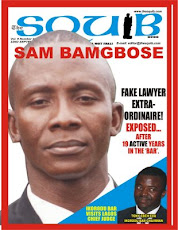
SAMPSON BAMGBOSE: IKORODU BAR UNMASKS FAKE LAWYER AFTER 19 YEARS


In a popular movie, the star actor was fleeing for his life. Hot on his heels were four gun-men with strict orders to bring back the actor’s scalp. Fortunately at the nick of tune, he gained a precious three minutes lead when his pursuers ran into a ditch and fell down.
In the confusion, the quarry disappeared from sight. The hunters knew he could only be in one place, a building some hundred meters away. Soon they were inside but were surprised to see that it was a museum of human statutes and wax works. In all the figures numbered a hundred, all of them life-like human sized and naked.
The hunters knew one of the statutes was their prey, but how to identify him presented a dilemma, for all the figures looked so real. To make matters harder, some of the figures could be seen laughing, yawning, smiling, winking and shaking their heads. One of them even spoke out in clear warm voice “Welcome!”
The killers decided to conduct physical examination of the figures one by one. To save time they split into four units. When the fellow to examine the actor turned emergency statute came to him, the ‘statute’ suddenly stretched out his right and hissed “You care for a handshake”? There was a dead cold glint in his eyes as he spoke. The examiner recoiled in horror and moved quickly to the next figure on the line. And so the day was saved for the lead character.
However one Mr. Sampson Bamgbose, an Ikorodu based, fake lawyer extra-ordinary was not that lucky. Just like the actor in our story, he had put a lot of ingenuity to escape detection. His luck and wits, to be fair, lasted quite a long while, nineteen years, but it could only go on so far.
In the earlier years of his career, Bamgbose, a man who by dint of forgery, ‘graduated’ from the MANCHESTER UNIVERSITY in the UNITED KINGDOM and by further dint of forgery ‘graduated’ from the Nigerian Law School in 1988 and by an additional leap of forgery called him self to the Nigerian Bar in 1989. He later established himself as a legal practitioner at Fadeyi, Ikorodu road area of Lagos State.
About three years ago Bamgbose relocated his ‘practice’ to Ikorodu Town. He set up-chambers in an entire building and at a time had three legal practitioner in his employ. In our story of the actor and his hunters, the escaped defection by blending expertly with his environment. He took to heart the adage. “When you are in Rome, do as the Romans do”.
This was the path Bamgbose also took. He did everything plansible to easily pass off as a truly qualified barrister. When he was a ‘Fadeyi, Lagos based lawyer’ he acted the part well. The story was no different when the impostor relocated his practice to Ikorodu Town (due to a hushed up office rent fraud). Bamgbose for starters set up chamber in an entire story building and did not hesitate let people know that he was called to the bar as far back as 1989.
By his claim, then there were only four lawyers, including the well known silk, Chief B.O.B Benson that were seniors to him in Ikorodu town. Accordingly many junior lawyers in the town gave him a lot of respect, addressing him respectfully as “senior”.
Sampson Bamgbose did not run one-man chambers. Within a year of his arrival in Ikorodu he had three legal practitioners in his employ. For good measure, Bamgbose became quite an active member of the young Ikorodu Bar and by year 2007, he had become important enough to be made the co-chairman of Law Week Committee. Claiming to be a qualified arbitrator, he almost presented a paper on the Practice and Conduct of Arbitration as part of that year’s Law Week Programme of the Ikorodu Bar. Amazingly, the impostor had headed a probe and disciplinary Committee of the Ikorodu Bar which tried some lawyers for certain misconduct! And to the knowledge of the Squib, Bamgbose had, at least one occasion hosted the monthly meeting of the Ikorodu bar.
As appearances go, Bamgbose had no problem in passing himself off as a legal practitioner. He dresses well, speaks good English and comports himself in a likeable manner. This is how a senior lawyer who has known Bamgbose for more than fifteen years described him. “I am shocked to learn that Sampsom Bamgbose is not a lawyer. He comports himself very well. He speaks English fluently. I have had discussions with him and I can say that he is intelligent. He is a likeable fellow, extra-ordinarily lively. There is nothing about him to suggest that he is not a lawyer. I am sure that his wife and children cannot believe that the man is not a lawyer.
Information reaching the Squib explained the downfall of the impositor as occasioned by a persistent rumour that ‘gentleman’ Bamgbose was a fraud. Distrubted by these rumours the Executive Committee, of the Ikorodu Bar mandated Mr. S.O.K. Owosile, the Secretary of the Bar to invite Bamgbose to a meeting with the E.C. so that the truth should be known.
Bamgbose honoured the invitation on 20 August 2008 and came with quite a packet of various certificates numbering 17 in all!
Bamgbose’s bundle of certificates was certainly impressive, but it did nothing to douse suspicious because of some disconnect in them.
For example Bamgbose claimed he got his Bachelor of Law Degree in 1988, from the University of Manchester, United Kingdom. Yet by 1989, he was already called to the Nigerian Bar 1989. This simply was not possible under Nigeria’s legal education where students of law who graduated from approved foreign Universities are required to spend two academic years, passing both the Bar Part 1 and Bar part 2 (Final) examinations before getting called to bar. Thus Bamgbose who supposedly graduated from the University of Manchester in 1988 could not have been called to the Nigerian earlier than in 1990.
When the Executive Committee of the Ikorodu Bar took him up on this score, Bamgbose told them that he was exempted by the Council of Legal Education from taking the Bar Part 1 Examinations! But when asked to produce the letter or certificate of exemption, the man got stuck.
Suddenly the Committee noticed another anomaly, this time in the Certificate of call to the Bar of Bamgbose. Please see cover story exhibit. The certificate bears two reference statute at the top, to wit- (i) The Legal Practitioner Act 1975 (ii) Law of the Federation of Nigeria 1990 CAP 207, yet the certificate states that Bamgbose was called to the Bar in 1989, a year before the law of the Federation of Nigeria was enacted!
‘Barrister’ Bamgbose had no answer to this discrepancy. Suddenly the ‘learned senior’ fell on his knees and started weeping like a baby and begging for a soft landing from the leaders of the bar. At a stage he promised to give two plots of land to the Ikorodu Bar if the leaders would be kind enough to save him the rigour of prosecution in the court of law.
The Executive Committee, bothered about participation of their branch in the then forth coming the Annual Conference of the NBA in Abuja (August 25-30) postponed immediate action against Bamgbose but collected the copies of his ‘certificates’ that he brought with him. Those copies were not originals but certified true copies of the forged documents. According to Bamgbose, the originals of his certificates were in the safe custody of Union Homes.
Soon after the NBA conference, the committee “pounced” on Bamgbose and dragged him to the police. Surprisingly Bamgbose offered some resistance before the police, denying that he ever accepted that he had been practicing law without the proper qualifications.
That pose however did not endure in the face of the penetrating questions of both the police and the lawyers. The man broke down and admitted that he was not a lawyer after he was confronted with the fact that his name could not be found on the Roll of Legal Practitioners in Nigeria.
He confessed that all his post-secondary school certificates are forged, but insisted the Nigeria Law School only that he stopped after failing the Bar Part I examination twice! Where is ‘Barrister’ Sampson Bamgbose now? As at press time he was still with the police. Although he was at first granted bail but when his sureties later approached the police to withdraw, the police cut his freedom.
All through last week, the police attempted to arraign the impostor to court but the magistrates were not in town (gone for computer training) The police hope to commence the prosecution of the smart alee on Monday, the 22nd September 2008, when the courts presumably will be open.

Sunday, September 14, 2008

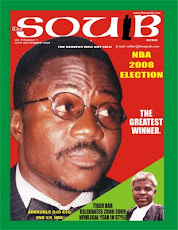
ADEKUNLE OJO THE GREATEST WINNER OF THE NBA 2008 ELECTIONS


On Friday 28th August 2008, the most important event of the just concluded annual conference of the Nigerian Bar Association took place at the central venue, the International Conference Centre. That event was the inauguration of the newly composed 14 newly executive committee leadership of the association.

Just about five hundred spectators mostly made up of conferees themselves and conferee watchers, to wit, journalists. This number was about a twentieth fraction of the whole that had participated in the week-long-mis-managed ‘fiesta’.
Those who did not care to stay behind to watch the coronation of the new leaders should not be blamed. By the evening of the previous day, the hurly-burly of the elections of that day (28th August that produced the new-leaders had been done-winners and losers had been known via a neat, free, fair and open election.

In the said elections, four of the office holders were returned unopposed. Those were the ones who strolled, so to say, into power. They were Rotimi Akeredolu (SAN) President, Ganiyu Ajape (Welfare Secretary) Linda Bala (Legal Adviser) and Gbolahan Gbadamosi (Assistant Publicity Secretary). One of the ‘srollers’, Rotimi Akeredolu, strictly speaking did not actually stroll into power, he could be said to have sailed into power after employing a ‘puff-adder’ tactics to successfully scare off a potentially dangerous rival Dele Adesina SAN from squaring off with him in he ring. But that is a story (a sweet, educative one for that matter) for another day.

The remaining ten officers, to wit Ikeazor Akaraiwe (1st Vice-President), Adekunle Ojo (2nd Vice-President) Barth Aniche-Okoye (3rd Vice-President) Ibrahim Eddy Mark (General Secretary), Francis N. Ekwere (1st Assistant Secretary), Muheeb Komolafe (2nd Assistant secretary), Marc Enamhe (Financial Secretary) Steve Onyechi Ononye (Assistant Financial Secretary) Tess Morris-Okeke (Treasurer) and Murtala Oladimeji Abdul-Rasheed (Publicity Secretary) fought their way to power.

In this category of officers, some had easier wins than others. For example Tess Morris-Okeke roared to the Treasurer position with a whopping 746 Votes leaving her only rival, hapless Ike Uko with a miserable 269 votes. Marc Enamhe on his own part chinched the financial secretary post by separating himself from the loser, Adetutu Siyonbola with 78 votes (541 to 463). As for Steve Ononye he cut Adekunle Ajasa of the Ikeja bar to size with a comfortable lead margin of 407 to 358 votes while the Mathisis Aodokemba who came last got 239 votes. Also Barth Okoye (552) became the 3rd vice president at the expense of Bode Makinde (405) and Edith Adoh Ogbuta (69). Murtala Oladimeji defeated his closest rival with almost 200 votes. He scored 443 votes while Denis Agbaga 262, Nwanunu Ogbona 261 and Rommy Mums 22. For the post of 1st Vice President Blessing Ukiri got a hiding from Ikeazor Akaraiwe who polled 645 votes to Ukiri 316 votes.

It was different strokes for these four officers Adekunle Ojo (2nd Vice-President) Ibrahim Mark (Gen Secretary) and Moheeb Komolafe (2nd Assistant Secretary) and Francis Ekwere (1St Assistant Secretary). These four came to power almost by the skin of their teeth. Komolafe with 366 votes won the race to become the 2nd Assistant Secretary with only three votes as against Jonathan Ainerua who got 363 votes while Paul Abiala got 280 votes. Ibrahim Eddy Mark got the nod to legitimately parade himself as General Secretary with a mere 15 votes lead over his closest rival Okey Ohwonda who polled 402 votes. In that same contest Carol Ajie with 133 votes came with distant third, G.C. Igbokwe fourth with 48 votes Anthony Oka fifth with 27 votes. Adekunle Ojo in his own case led the pack with 317 votes defeating his closest rival Rueben James with a mere 30 votes, with Iniabasi Udobong came third with 240 votes, N.H Nwankwo fourth with 137 votes and C.A.C Uzoegwu fifth with 53 votes. As for Francis Ekwere he became 1st Assistant Secretary at the expense of Asafa Olalekan Yusuf his closest rival with only 36 votes scoring 417 to Yusuf’s 381. Joe Egwu came last in that race with 219 votes

In the considered opinion of this magazine Adekunle ojo was the greatest winner of the election. Yes he did not have the highest number of votes like Tess Morris-Okeke The treasurer or crushed a political giant, the way an Ikeazor Akariwe (1st Vice President) dismantled and demystified a valiant like Blessing Ukiri but Ojo’s victory was singular and unique in one significant regard-he won in defiance of the POLITICS OF TRIBALISM which ethnic irredentist groups like the Northern Lawyers Forum, Eastern Bar Forum and Egbe Amofin Yoruba (west) have glorified and regularly touted as the only sure-fire platform of gaining important political office, in the NBA at the national level.

Most of the leaders and promoters of these tribal irrendentist groups are elderly, relatively wealthy lawyers, thus the leadership characteristics of these groups are tribal, plutocratic and gerontocratic. A good number of the few younger lawyers who have roles to play in the leadership of the groups are essentially messengers and (ego) massagers of the “great, venerable ones”.

Taking advantage of the respect people have for their advanced age at the bar and in life as well their positions in life, leaders of tribal lawyers groups, in their enclaves make their preferences of available candidates and in almost feudal manner and method work to impose their preferences on the voters, working through the leadership of branches of the NBA in the respective regions. Since these irrendentist groups are sectional and tribal, the stark truth is that they are not nationalistic in outlook nor any great promoter of merit and are consequently and basically unprogressive. Of course it is highly anomalous to think of the groups as either reformatory or revolutionary.

Nonetheless because of their posturing as the king-makers of the NBA many a candidate crawls to them for support and blessing and bow out of contest, where they fail to get the support of the ‘ethnic irrendentist groups.’ So much in awe of the influence of these irredentist groups, that the incumbent president, Rotimi Akeredolu, a reputed fire-eater and a progressive not only found his way to the tribal power caucus in his ethnic base, (Egbe Amofin Yoruba) he so wormed his way into the heart of the leadership of the group that they declared him their sole candidate and scared off a ‘scareable’ contender, Dele Adesina SAN from the race completely even though Adesina was a foundation member of the Egbe. Not only that, Akeredolu in the thick of his puff-adder style campaign trumpeted it for all to hear that other irrendentist groups particularly “Eastern bar Forum have endorsed me!”

In this year's elections the only candidate in the big league who did not seek to actualize his ambition on the platform of tribal/regional approval was Adekunle Ojo, the incumbent 2nd Vice President. Arguably a candidate like Blessing Ukiri (1st Vice President) could be said to be in the same league but the important distinction was that while Ojo did not even attempt to seek approval of his political ambition from the Egbe Amofin Yoruba the irrendentist group in his area (west), Ukiri actually did that of his (Eastern Bar Forum) but only marched on defiantly after he failed to gain the support of the EBF.

In retrospect, it is doubtful that even if Ojo had sought the blessing of the Egbe Amofin, whether he would have received her blessing. Elated and gratified that the Egbe has produced the ‘President without opposition’ in the person of Rotimi Akeredolu SAN, the Egbe in their wisdom traded off all other big league posts (The three Vice-Presidencies and the General Secretary) to other regions. This predisposition was said to be based on the interest of the Egbe to see that the NBA leadership reflected federal character and balance.

Although even recent history taught otherwise, the Egbe had no interest in that aspect of history. In 2000 O.C.J Okocha SAN became president while General Secretary was Phillip Umeh. Both were South Eastherner Nigerians. In 2002, Wole Olanipekun SAN was president, Funke Adekoya SAN was 1st Vice-President, Dele Adesina was General Secretary. All of them were Yorubas and south Westerners and apparently the Heavens did not fall. That regime is still regarded as the best so far in the NBA since 1992.

In 2004-2005 both the president and 1st Vice-President Bayo Ojo and Lanke Odogiyan were not only Yorubas but both practiced in the North. In 2006-2008, the president, 1sdt vice president, 2nd vice-president (Agbakoba, George and Blessing Ukiri) are all South Easterners, with the 1st and 2nd vie-president from the same branch-PortHarcourt).
Holding to their interesting “federal spread” agenda, the Egbe Amofin Yoruba talked out Nurudeen Ogbara, the energetic and resourceful chairman of the NBA Ikorodu branch out of the contest for the position of Genral Secretary. Ogbara’s credentials count for nothing in the calculus of the Egbe, even though he is the only westerner in the race as the dynamics of politics go, had a fair chance of winning considering all the other contestant are South-Easterners.

For the same reason, the Egbe was not disposed to the candidacy of Adekunle Ojo in the 2nd Vice-President slot. However it would appear that the Egbe had some other reasons for their disapproval of Ojo’s candidacy.
At her meeting of the 26th August 2008, in Abuja, Ojo’s candidacy was an item of discussion. While nobody came out pointedly to ask Ojo to drop his ambition the Egbe would have felt better with his withdrawal from the race.

Curiously the Egbe openly and enthsiastically endorsed Bode Makinde, a Yoruba too, but of Yola Branch for the 3rd Vice-Presidency. According to the Egbe, the Northern caucus was promoting Makinde a Yoruba, as their candidate because he practiced in the North and in return was asking for support of the Egbe for their prime candidates, presumably Reuben James of Kaduna branch and Ibrahim Mark for General Secretary.

Of all the chieftains of the Egbe present at the meeting, it was only Mrs. Adekoya who spoke out clearly in favour of Ojo’s candidacy. “What have we got to lose if we support our own son, whom we know is a good material?” asked the lady. There was no clear answer to that plain and reasonable question.

On the 27th September 2007, the Egbe called another meeting of its chieftains and chairman of the various branches of the NBA in the West.
It was a meeting that clearly revealed the exclusive methodology of the Egbe. At the venue, the chieftains, about ten of them led by Chief Bamidele Aiku S.A.N huddled together in ‘tight’ conference while the chairmen were kept waiting and idling away, looking very inch like a corps of pressmen waiting for a post conference press briefing!
After the Egbe chieftains finished their meetings, the chairmen were called and a list of names of “approved” candidates for various pots under contention was released. The list included Adekunle Ojo’s name.

On the surface it appeared everything was okay but in reality the issue of Ojo’s candidacy was far from settled in the Egbe. The list actually was a dummy. Fortunately Ojo and his campaign organisation were not fooled.
They correctly smelled greater danger in the “approval” of the Egbe. A band of hardy, shrewd campaigners the Ojoists did not go home – rejoicing at the Egbe’s ‘approval’ of their candidate, but rather revived their campaign machine, the harder, so much so that as at 2.00a.m on the morning of the Election Day, they were searching reaching out to delegates, especially those from the Northern part of the country.
Ojo’s campaign effectively started middle of July 2008, at least two months late. The take-off was delayed by the succession crisis that rocked the Ikeja bar, Ojo’s home base at the tail end of the Niyi Idowu administration.

The problem was because the strongest political caucus in the Ikeja imploded and split into three factions. The biggest of the faction included Ojo and it was that faction that eventually carried the day, sweeping the polls completely, leaving not even crumbs for the vanquished opponents, their former comrades.

The victory was costly and took precious time. It was not until June 30 2008 that the new leadership of the Ikeja bar came on board; traditionally in the Ikeja bar, new leaderships emerge on the 1st Monday of the month of June.
Having secured the home base, the Ojoists threw their considerable energy into the quest to make Ojo become the 2nd Vice-President. Road campaigns were mounted ceaselessly into various parts of the country, such that within a space of three weeks, no less than five thousand kilometers were covered.

These campaigns were not quiet or lonely affairs. Believing the Adekunle Ojo was an excellent Tiger bar product, the Ojoist simply branded his candidacy as an Ikeja Bar Project.
To actualize the project, the Ojoists firmly in power in Ikeja donated completely the campaign veteran Adesina Ogunlana, Publisher of the Squib and Welfare Secretary of the bar to the Adekunle Ojo campaign organization as Chief, while other key members of the Executive, including the very chairman became members. More, the bus of the branch was thrown in as campaign material, and it was this branded vehicle that the Ojoists rode like a Bacephelaphus to the nooks and crannies of Nigeria in search of votes. It was clear that if the group had lost the struggle to provide the successor to the Niyi Idowu leadership the Ikeja bar, the funds also poured into the Ojo for 2nd Vice-President would have died ab ini tio war-chest of the Ojoists from open and secret friends and sympathisers of the group. The campaigners had an easy time selling their product in all their travels.

At the Onitsha NEC, Ojo had given a heart-warming performance at the speech-making programme for candidates. Even though he spoke for just about three minutes he had impressed many of his listeners as a bold, resourceful, pragmatic, “action man” who would do well in the 2nd Vice-President position.

But his Onitsha performance, scintillating as it was, it was a mere fillip. Ojo’s dues as a competent bar leader had been paid in those glorious years of his chairmanship of the Tiger Bar. It was a fact that so pro-active was the Ikeja bar under Ojo, than when he as chairman spoke, layman often thought it was the president of the NBA that was on the air.
Yet such a good hand, left to the Egbe should be rusticated and prevented from serving the NBA at a larger for a, to achieve a “federal spread”.
In the race for the 2nd Vice-President there were five candidates but only three – Ojo, Rueben Jame and Udobong had any real enhances of winning. The other two – N.H Nwankwo of Owerri branch and C.A.C Uzoegwu chances were chances were hopeless, as the Squib in its conference edition of 25th August 2008 correctly divined.

Of the three leading candidates only the one was not dependent on ethnic/regional support. Rueben James of the Kaduna branch relied heavily on block votes coming fromt eh North as well as alliance with the Egbe Amofuin – Yoruba, who clearly favoured the passive Northerner to the at first, that it was going to be a classic illustration of the Yoruba adage
“Kirakita o dola
Oluwa ni gbe ni gaa!”

After the voting, the sorting and counting of the ballot papers, took about ninety minutes. These ninety minutes were like ninety years, as victory only kissed Ojo’s fore-head, only about the last ten minutes.
Infact the very first thirty minutes were very bad as votes for Rueben James just kept tumbling. James’ pile continue to grow Yong Turk from Ikeja.

Iniabasi Udobong relied on block votes from the Eastern Region, courtesy of the Eastern Bar Forum which had adopted him. To his credit too, as better information later showed, he made some campaign outside his South-East base.
Ojo, the eventual winner of the contest was the only candidate who put his destiny and fortunes in the hands “of delegates wherever they can be found in Nigeria.”

To be sure, Ojo had the busier, paciest and the most frenetic campaign in the race, but on the actual day of voting, it appeared Bigger, falter and high while Ojo’s retained an embrassing dwarfish stature. For every single Ojo’s vote, six, even seven of Rueben James' would come in. It was a repeat of the famous 1999 Peoples Democratic Party’s primary Election Abuja of Obasanjo, Obasanjo, Obasanjo, Obasanjo, Obasanjo, Obasanjo, Obasanjo, Ekwueme”!
Adesina Ogunlana and Seyi Olawunmi, Ojo’s agents could not believe their eyes. It was not looking like a mere defeat for Ojo a humiliating rout of their candidate. And that certainly was not what they came there to meet.
At a point Ogunlana’s joke that there was too much tension in the atmosphere was confirmed by Linda Bala, Rueben James’ agent in a cool confident.
“There is no tension for me. I came here with faith and as you can see, my faith is working for me”!
And Ogunlana had no choice but to reply gamely “Time will tell” but the two Ojoists were only trying to hide their worst fears.

He remembered that two years ago, Ojo had lost out to Blessing Ukiri for the same position despite a brilliant and hard campaign. He remembered the lecture that he and Ojo had received from Niyi Akinlola SAN, just about an hour ago, while voting was in progress that it was unwise of anyone to disregard the wisdom and influence of the Egbe Amofin. Boasted the learned silk “We (Egb Amofin elders) are like the proverbial door- we see (into) the inside and of course we see (into) the outside. You have to understand the political arithmetic (of ethnicity) in the NBA”
He remembered the July 2008 warning of a Senior Progressive Bar Forum (Ojo’s political group in the NBA) there PBF members especially outside Ikeja that would work against Ojo’s interests in the election.
Half-way into the sorting of votes, the tide started slowly to turn against Rueben James. More and more votes began to pour in for both Ojo and Udobong. James’ leadership got arrested, than detained, while Ojo continued to catch up with him it was now Linda Balas’s turn to sweat and squirm.
Udobong’s pile too continued to rise but he was not too much of a threat to anybody.
Nobody knew exactly when James surrended his lead to Ojo but the important fact was that Ojo won. He snatched victory from the jaws of defeat, almost at the last minute.
It was one victory that clearly demistified and debarked the propaganda of the invicibility of regional/ethnic power caucuses, particularly the Egbe Amofin Yoruba.

For those who know their history the Egbe was actually a paper tiger and was paling into insignificance before the timidity of Dele Adesina S.A.N allowed the Egbe to produce a sensational coup of installing a so called “consensus” candidate the president of the Nigerian Bar Association in 2008 in the person of Mr. Rotimi Akeredolu SAN.

It is a historical fact that in 2004, the Egbe turned her back on Chief Bayo Ojo SAN, giving their support to A.B Mahmoud SAN of Kano. Mahmoud lost. In 2005, the Egbe was opposed to the emergence of Prince Lanke Odogiyon also a Yoruba, as president of NBA but the president became president.

In 2006, in a glaring case of inconsistency and contradiction, the Egbe had pioneered the controversial zoning formula lent their support to the Westerner, to Funke Adekoya’s (SAN) bid to become president even when the zoning formula favoured the East.
Of course, Adekoya came an embarrassing last in a race that on sheer merit, she was the best and most suitable. Egbe, Chief Aluko-Olokun S.A.N of the Kaduna branch. On Friday the 29th August 2008, the learned silk came to the International Conference Centre, obviously to attend the new leaders of the Association elected the previous day. There at the “verandah” of the ICC, he saw Adekunle Ojo receiving congratulations from friends and foes yesterday but friends today, alike. The old man moved over to Ojo and spoke these unforgettable lines:

"Ha, I campaigned against you yesterday. I campaigned o, but you won. This (your victory) could only be by God’s favour. That your God is powerful. Continue to worship Him. We worked against you because we were afraid that the Hausas will complain that they have no top-notcher in the new administration. But little did we know that even the Hausa people themselves would vote for you.
Now that you have won, we should accept it as the wish of God."

Monday, September 8, 2008

NBA 2008 ELECTIONS: WHO WINS, WHO LOSES?


It was in the mid-70s. A crowd of about one hundred and fifty had gathered in the small playing field of a little primary school. They were not there for a soccer match or a religious programme. They had come to be entertained by a magician. A song was see-sawing through the crowd.
“Come and see
American wonder,
Come and see
American wonder,”

The ‘wonder’ that the crowd had come to see was right in the middle of the centre - a headless human body, yet talking¸ with hands and legs very much alive and active.
In those days, in our climes magicians were regarded as supermen, truly capable in fact of achieving feats as having a headless being eating and talking. Only a few realised that the so called headless wonders are nothing than a jiggery-pokery created strictly to entertain a naive crowd and transfer the contents of their pockets to the supermen’s.
In the political affairs of the Nigerian Bar Association, specifidcally the approaching general elections taking place on Thursday 28th August 2008, what is on ground presently can, in a light-hearted manner be said to be a case of a “bodyless wonder” as opposed to the “headless wonder” of the magical tricks of yore afore-mentioned.
Watchers and followers of the issues and trends in the political currents of the NBA will easily appreciate the ‘bodyless wonder’ label. There are fourteen offices in the Executive Committee of the Association to wit President, Vice-President(s) (3), General Secretary, 1st Assistant Secretary, 2nd Assistant Secretary, 2nd Assistant Secretary, Treasurer, Financial Secretary, Publicity Secretary, Assistant publicity Secretary, Welfare Secretary.
Incidentally, in the 2008 General elections, only ten out of these fourteen offices are open to contest, as four have been filled by candidates who returned unopposed.
These four offices are President (Oluwarotimi Akeredolu S.A.N), Legal Adviser (Linda Rose Bala) and Assistant Publicity Secretary (Gbolahan Gbadamosi) and Welfare Secretary (Ganiyu Ajape). So, as the situation is, the apex leadership of the association is already determined, sans contest.
The story of how Akeredolu S.A.N attained the presidency of the NBA in 2008 without contest and the implications of this “strange development” will take quite a while to tell and absorb. So, we will not let it detain us here.
Clearly, the absence of a presidential contest in the forthcoming elections has lessened the quality of excitement in the politics of the association. But it has by no means extinguished the heat thereof, at least in the contest in the following offices: 1st Vice-President, 2nd Vice-President, 3rd Vice-President, General Secretary, and Publicity Secretary.
Infact, the contest in some of the afore-mentioned offices, as our analysis will show are not only very keen but intriguing.

THE 1ST VICE-PRESIDENCY
There are only two contestants in this race – Ikeazor Akaraiwe and Blessing Ukiri. Both men are called to the bar the same year, in 1985. They are also from Delta State of Nigeria and both practice in Southern Nigeria. While Akaraiwe, who at 46 is the younger man by two years, practices in Enugu, Ukiri practices in Port-Harcourt.
The two contestants are hinging their electability on various strengths. For example, Ukiri who definitely leads in terms of years of cognate experience and exposure at the leadership cadre of the NBA at the national level (was a Former National Financial Secretary, 1998-2000, 3rd National Vice-President, 2002-2004, 2nd National Vice-President, 2006-2008) boasts of having the proper and adequate grooming and pedigree to successfully serve as the association’s 1st Vice-President. On the other hand, Akaraiwe the relative “green horn” at national level leadership, but who had served commendably well as a Former Chairman of the Enugu branch of the NBA, and who wears urbanity suavely as a well-fitted suit is challenging the Ukiri’s presence with a call for “fresh blood and fresh vision” in the running of the affairs of the NBA, parading himself as a man with a better vision and greater integrity than his rival.
Akaraiwe’s posturing may have struck a chord with some voters who contend that Ukiri has stayed too long in the corridor of power and should yield ground to a new face.
However attractive, even seductive as the Akaraiwe persona maybe, the question is whether, he is strong enough to stop Ukiri from becoming the 1st Vice-President of the NBA? No doubt a veteran bar man, Ukiri is easily one of the best known faces in the NBA. A ready mixer, who has crawled with the lowly and flown with the mighty, for years in the corridor of power in the NBA, it is not out of place to dub Ukiri “Mr. Contacts.” Ukiri’s history of electoral contest in the NBA show that, Akaraiwe, despite the alleged official support of the Eastern Bar Forum for him, will have an uphill task in upstaging.
In the three previous elections he had participated in, at the national level, Ukiri had only lost one, and this very narrowly (by two votes) to D.D Azura of the Yola branch in 2004 in his quest to become the 2nd Vice-President.
In 2006, Ukiri overcame a very stiff challenge from his only rival, Adekunle Ojo Esq, the famous chairman of the prominent Ikeja branch to become the 2nd Vice-President of the Association.
A veteran of NBA politicking, Ukiri comes armed with a big campaign chest, to ensure that delegates sympathetic to his cause and even those who are undecided cast their ballots for him.
Except something dramatic and drastic happens, especially in the last three days before the election debonair, Akaraiwe may find himself on the ground gasping for breath. His radiant flower may not survive the harsh, hot breath of the political opposition.

2ND VICE-PRESIDENCY
There are five contestants for the office of the second Vice-Presidency. They are as follows C.A.C Uzoegwu (Owerri), Reuben James (Kaduna), Iniabasi Udobong (Uyo), Adekunle Ojo (Ikeja) and N.H Nwakwo (Owerri).
A realistic appraisal of the strength of these contestants show that only three are in serious contention - Adekunle Ojo, Reuben James and Iniabsi Udobong. While C.A.C Uzoegwu is virtually unknown at the national level of the NBA and N.H Nwankwo who is better known appears to be in the race, either for the sheer fun of it or merely to be known, as an also run considering the fact that his campaign so far has the energy of a snoring ox. Of the three “serious candidates”, as at press time, the odds appear to favour Adekunle Ojo, who has been quite energetic in his cross-country campaigns.
The former leader of the famous Ikeja leader of the NBA who did extremely well as the chairman of the Tiger branch between year 2004-2006 is not only well respected and accepted in the Southwest, his immediate Constituency, but he has, by his relentless campaigns to many branches of the NBA in the Eastern, Midwestern and Northern parts of the country in the last four weeks, gained serious in-roads in all these areas, where his big theme and visions may be translated thus:-
“A Vice-president is the President of his zone and his the connection of the central leadership with the branches” who.
Bold, assertive without being aggressive, Ojo could be an arresting, even scintillating public speaker. This ability was on display at the Onitsha NEC meeting where he completely out-shone his opponents during the speech-making programme of the candidates in the elections.
Inspite of his strengths and present advantages on the field, it is not yet a done deal that Ojo will get the 2nd Vice-Presidency.
Also in contention is Reuben James, the Kaduna based incumbent 3rd Vice-Chairman of the NBA. Inspite of the height of the political stakes, it is curious that James is relying only on a singular weapon and system to become the next 2nd Vice-President of the NBA. This weapon is called “block votes” or regional anointing.” James hopes to gain massive support from Northern branches who are his immediate constituency, not by direct approach and campaign to these branches but by re-jigging the Northern tribal counterpart of the West’s “Egbe Amofin Yoruba” and the East’s “Eastern Bar Forum” known as the Arewa Lawyers Forum, in a way such that forum will no longer be open to any Northern based legal practitioner but only to practitioners who ethnically or regionally are from the North.
Fortunately or unfortunately, this move is causing strong winds of disaffection amongst legal practitioners in the North, as those who are not of northern extraction but practice there, feel alienated and as such are prepared to refuse Reuben James and any of his co-travelers any electoral support.
Another complaint against James is that he appears rather complacent in his attitude of minimal physical campaign, even in the North the man hardly stepped out of his Kaduna base. But interestingly, this tepid and regular candidate appears to be acceptable to certain chieftains of the Western Yoruba irredentist lawyers group (Egbe Amofin Yoruba) ahead of Adekunle Ojo, on the ‘wonderful’ ground that no Yoruba ought to hold any vice-presidential posts since the presidency is occupied by a Yoruba.
In the East, conventional wisdom is that James has little support but that may change, if he enjoys favourable horse-trading in Abuja. Such an ‘if’ appears doubtful however in the face of the candidacy of Iniabasi Udobong of Uyo branch who is said to be the anointed candidate of the Eastern Bar Forum.
The possibility of Udobong succeeding in the race exist but appears very slim. Even less colourful that the rather passive James, Abasi has no known pedigree in the NBA, at least beyond his Uyo enclave and as such should not trouble the two front runners, Ojo and James, particularly the former, particularly since he like James, has not done much in terms of road campaigns like Ojo.

3RD VICE-PRESIDENCY
Of the three contestants in this category-Bode Makinde, Barth Okoye-Aniche and Sir Edike Ike Adoh-Ogbuta, only one name does not ring a bell-Adoh Ogbuta’s.
Except for lawyers in Agbor and its immediate environs Adoh-Ogbuta could well have been a Martian, so much for the completeness of his anonymity.
The other two candidates are by no means Messers Anonymous, as both are incumbent national officers. Arguably the better known of the duo is Barth Aniche-Okoye, who between 2004 and 2006 was NBA’s publicity secretary and has been the Welfare Secretary since 2006.
Bode Makinde, is the outgoing Financial Secretary of the association and has become fairly well known too in the association.
It is either of these two men who will become the third vice-president. The question is who? Because Makinde is a westerner based in far North (Yola) Makinde might just beat Aniche Okoye to it, since he has enough pleasant political character to collect votes easily in the west, by reasons of consanguinity and substantially too in the North by reasons of affinity, leaving Aniche only votes from the Eastern part of the country and some parts of the Midwest.
Bode Makinde, despite certain resentment against Anichie-Okoye for having stayed too long a stay in the corridor of power in the NBA and becoming one of the so called and much derided. “NBA practitioners” would be naïve to think that the contest is already won. Far from it!
This is because in Aniche-Okoye, lies a formidable rival who is a shrewd political animal, gifted with a warm, friendly personality. Very personable, Aniche-Okoye has lots of contacts in the NBA, and quite good at one-on-one political persuasion tactics. A serious contender that he is, Anichie-Okoye even carried his campaigns to the west, quietly making new contacts and renewing old friendship.
That means that Makinde cannot take all the votes in the west for granted and for that matter, even those in the very North where he, practice wise, comes from.
From all indications, the two contestants may end the race, neck to neck. For now, it is rather too close to call.

GENERAL SECRETARYSHIP
In the tradition of the NBA, only the presidency is coveted more than the office of the General Secretary. The reason is not far fetched-the office of the General Secretary under the NBA constitution is central to the administration of the association and has rightfully earned the appellation the “engine room”.
Now, (2008) like in the past, there is quite a crowd of candidates out there, six in fact, contending for this office which however can only accommodate only one of them. The six are as follows: Anthony Oka (Abakaliki), Carol Ajie (Lagos), Ibrahim Eddy Mark (Maiduguri), Chidi Nworka (Owerri), Okey Ohwonda (Port-Harcourt) and G.C. Igbokwe (Benin).
Clearly this is a very well stretched field, with as many opponents, as diverse abilities, strengths and weaknesses. None, on individual basis is a push over, but in political skills and weights, some are, for certain factors more formidable than others.
In terms of sheer visibility, but not necessarily popularity or acceptability, the foremost candidate is Carol Ajie, the former Secretary of the Lagos Branch and who holds the record of being the most consistent (some say perennial or perpetual) same office - contestant in the NBA.
Ajie is contesting the General Secretary position for a record of fifth time. In year 2000, when she first came out, the race went to Chief Phillip Umeh of the same Lagos Branch. In 2002, she and others lost to Dele Adesina S.A.N. In 2004, she was again in the losers’ corner when, Nimi Walson Jack of Port-Harcourt carried the day. In 2006, when she had her best outing till date, by coming second in a four cornered race, the medal went to Rafiu Lawal-Rabana of the Ilorin branch.
In this year’s contest, can the self dubbed Abraham Lincoln of the NBA gain her heart desire? If the contest were only among her and G.C. Igbokwe, Anthony Oka and Chidi Nworka, the answer might be an easy YES.
As far as the Squib can see, Igbokwe, Oka and Nworka have slim chances of clinching the post. Igbokwe who is contesting the secretary for the third time simply lacks the colour and clout to generate massive sympathy from voters. Even in his immediate constituency Edo State and by extension Delta State, a more vigorous and compelling campaigner in the person of Carol Ajie appears to have gained the upper hand. Probably for lack of adequate campaign funds and delayed take-offs, Igbokwe does not possess enough stature to come out tops.
As for Anthony Oka, his chances do not appear too bright inspite of his personal brightness and strong self-will. A strong contender for the post of General Secretary must campaign-wise be very mobile, and touching base with as many branches of the association as possible, in addition to having a welter of contacts, and a dependable network of allies.
However since Oka appears to be lacking in direct campaign mobility and has to jostle from the rear for space in the Eastern Bar Forum against Okey Ohwonda, it will be a miracle if he comes within the first three in the contest.
This year, in all probability will not be Chidi Nworka’s year. Sadly, not for reasons of ability. At the Onitsha NEC meeting, Nworka had one of the best presentations of all the candidates in their speech-making. Tall, calm and collected, Nworka came across as a knowledgeable person who can responsibly discharge the duties of the NBA general secretary. But mere ability is not enough to gain a candidate the big office of a general secretary of the NBA.
The hottest names in the race belong to Okey Ohwonda and Ibrahim Eddy Mark. Incidentally both of them are Ikwerre indigenes of River State. Also both of them have links to O.C.J Okocha S.A.N,the godfather of NBA politics in the South East, although Okocha is said to have pitched his political tent over Ohwonda.
Ohwonda also officially has the blessing of the Eastern Bar Forum, although as at press time other candidates like Oka, Nworka who are from the East have kicked against the adoption of Ohwonda by the EBF and are refusing to back down from the race.
Ohwonda has carried his campaign well beyond the Eastern Bar forum, into many parts of the country. He went deeply into the North, not forgetting the West and the Mid-Western parts.
Armed with an impressive campaign chest, which is the envy of his rivals, Ohwonda is certainly a big-contender in this race. But formidable too is Ibrahim Eddy Mark. A veteran bar man just like Ohwonda, he has the added advantage of having the right to claim multiple constituencies, being a South-Southerner but having his practice base in Maiduguri (Far North) meaning that he is by birth and ethnicity, a Southerner but by practice location, a Northerner.
Pleasant and a ready mixer, Mark is being touted as the ready-made candidate of the Arewa Bar Forum. Nothing however in this regard is certain for the moment, as other candidates particularly Ohwonda has repeatedly crossed the Niger to fish for votes. On his part Ibrahim has sailed down the Benue to hunt for votes too in the South generally.
At the end of the day, the fate of these two may be determined one way or the other by one factor:- last minute horse trading between their respective god-fathers and caucuses.
Interestingly, both of them are in danger of canceling out each other and giving opportunity for Carol ‘Abe Lincolin’ Ajie to come-in from the cold, after eight long years, to become the General Secretary of the NBA.
This is how the possibility can come to pass. Troubled in the South-East by Nworka, Oka and also by Mark in the East, Ohwonda will manage only about 60% of the votes, instead of an emphatic 80% or 90%. In return Ohwonda, Nworka and possibly Igbokwe and Oka will disturb Mark in the North, leaving him with maybe 55% of the votes. Now if both Mark and Ohwonda do poorly in Lagos and the West, with Carol in emphatic domination of the Mid-West, coupled with her steals in the East and the North, the trophy might just go to her.
This scenario may not be far fetched as it seems. In her last time out, Ajie came second, albeit a distant one, but that was only because there was no candidate strong enough in the race in 2006 to substantially weaken or affect the front runner, Lawal-Rabana.This year, the Ajie candidacy is particularly dangerous to rivals. She has adopted a seemingly potent strategy of advocating herself as the best candidate for the job on merit but also lacing same with appeals for support on the basis of gender balance and reward for persistent re-applications to get the job of General Secretary. Infact, but for the inability of Ajie to shake-off the rather vote-scaring stigma of not being a comfortably conventional persona, the chances of both Mark and Ohwonda would have been in serious danger. Nonetheless, Carol Ajie might just swing it but the odds favour Ohwonda and Mark the more with Ohwonda having a slight upper hand at least as at press time.

TREASURER
There are only two contestants here - Ike Uko of Lagos branch and Tersis Morris- Okeke. Morris Okeke had to overcome disqualification battles mounted by Uko to be in the race. Being somewhat more visible than Uko and having the support of some big fish in the NBA, as well as the blessing of the ‘large’ Port-Harcourt branch and the Eastern Bar forum, Morris Okeke seems to have a greater chance of winning Uko, who is not too well known, outside his Lagos branch.
Already Morris-Okeke is being addressed as Madam Treasurer. Is this a sign of things to come? Most likely than not is the answer, particularly as Uko appears lacking in the necessary fire power to overwhelm his opponent, in practical terms.

PUBLICITY
There are three main contenders here – Dennis Agbaga (who has been dubbed, rather uncharitably by his opponents as the “weeping candidate”, Ikechi Ogbonna Nwanunu (Isiala Ngwa) and Murtala Oladimeji Abdul-Rasheed (Kaduna) Agbaga of the Warri branch is contesting the Publicity Secretary for the third consecutive time. In 2004, he lost understandably to Barth Aniche - Okoye, in 2006, he lost shockingly to Linda Rose Bala. Will he lose again this year?
From all the readings on the ground so far, Agbaga will have to really work hard to realise his ambition. The graver threat to his success lies in the person of Abdul-Rasheed a.k.a Murray. As a rule, Northern based, South Westerner candidates are often difficult to beat, moreso as Murray is the out-going Assistant Publicity Secretary, by virtue of which post, the size of the toga of his anonymity at the national level of the NBA has substantially reduced.
To Murray’s credit, he has campaigned the hardest of the trio, even though he could have done better. As for Ikechi Nwanunu, very well known in his Isiaka Ngwa branch, it is doubtful whether his name rings a bell substantially anywhere else outside his branch or State as a bar man or activist. His campaign so far has been low-profile, with virtually non existent road campaigns, with the unfortunate consequence that this otherwise god hand is to many voters at best a disembodied voice.
However, if Nwanunu gets block votes from the Eastern Bar Forum and some string friendly votes in other parts of the country, he might just be in contention.
As for Agbaga, he got the appellation “weeping candidate” on account of his speech to the attendees of the Onitsha NEC meeting. Agbaga spent his time reminding his listeners that he was contesting consecutively for the post as if that in itself was a virtue!
Nonetheless, Agbaga’s “have mercy on me, cry-cry baby” tactics may bring additional votes to his collection, but his case would have been made much better by far and wide ranging campaigns (and on issues) and not being merely dependant on “block votes” from the Mid-Western lawyers’ Forum. As things stand today, Murtala- Abdul Rasheed Oladimeji seems to be the man to beat.

1ST ASSISTANT SECRETARY
This is a three cornered contest, that is Joe Egwu of Agbor branch, a former two time Executive office holder, actually participates. At the Onitsha NEC meeting, Egwu popularly known in the past as a “secretariat boy” did not participate in the speech making programme for candidates and he has not been seen or heard, except maybe in Agbor, Delta state, campaigning.
The other two contestants in the race - Asafa Olalekan Sanusi (Oshogbo), Francis Ekwere (Eket) also seen to have taken a joint vow not to do any form of campaigning aside distributing hand-bills during NEC meetings.
Consequently, none of the contestants has brought any zest or colour to the election. The basis of comparative analysis of their chances at the polls hardly exist then. The race may go to any of the dull trio.

2ND ASSISTANT SECRETARY
This is another seeming innocuous posts, with all the contestants virtual unknowns. With the exception of Jonathan Ainerua, the candidates have restricted their campaigns to their door steps and backyards.
Moheeb I. Komolafe of the Abuja branch is a contender and also contesting is Paul O. Abiala of Calabar branch.
If political hardwork pays, Jonathan Ainerua, a calm and collected youngman, should get the voters’ nod to occupy the office.

ASSISTANT FINANCIAL SECRETARY
There are three contestants in this category, and all of them, not so well known outside their branches. They are Mathisis Aondokemba (Bauchi), Prince Adekunle Ajasa (Ikeja) and Steve Onoye (Onitsha). Because of their unanimous anonymity, it is difficult to say who of them will emerge victorious. However, at the Onitsha NEC meeting, during the speech making event only two of the contestants showed up. They are Ajasa of Ikeja and Onoye of Onitsha. Ajasa easily stood out, partly because of his great height (6ft 4”) and his impressive credentials as a “tested and experienced banker, chartered accountant and finance expert.” He stands a good chance of getting elected.

FINANCIAL SECRETARY
There are only two contestants in this category – Adetutu Siyanbola of the Lagos branch and Marc Enamhe of Ogoja. Marc Enamhe (of the rural branches fame) is the better known of the two, notwithstanding that Siyanbola in 2002-2004 was a national officer under the Chief Wole Olanipekun S.A.N administration.
Curiously, both candidates have decided to go on minimal campaigns. The race however should go in favour of Enamhe considering his popularity vis-a-vis Siyanbola’s

Saturday, August 2, 2008

IS THE NBA DYING?

SQUIB BAR NEWS

On the surface, the Nigerian Bar Association appears to be doing well, very well indeed. For one, the association is prided as the leading and credible professional association in the country, which many presume gets the ear of the government when it decides to speak.

Also, one often reads in newspapers of how certain specialized sections and fora of the NBA are doing wonderfully well.

Of course the perceived glitter on the NBA may reflect more in August when the Annual Conference holds in Abuja for the sheer number of participants that may turn up. There is safety and perhaps comfort in numbers.

Despite the rosy picture that the NBA presents to the world, there are understandable fears that the beloved association may actually be on its way to the grave. This awful possibility is, however only appreciated by reflective members of the association.

One sign that the NBA may not be in good health is that for years, the number of her branches has remained 88, as if there was a perpetual injunction on the association restraining her from enlarging her coast despite the fact that her membership swells every year with hundreds of new entrants into the legal profession. Another reason the NBA may soon be in a morbid condition is that a vast majority of lawyers, especially the young ones, do not have a sense of belonging to it. The situation is so bad that some young lawyers do not even know what the acronym ‘NBA’ stands for, talk less of caring to attend any meetings or functions of the association or her branches. It is believed among many junior lawyers that the association is unconcerned about the improvement of their welfare, particularly in terms of helping them to get gainful employment and exposure.

To make matters worse, many young lawyers, due to the poor economy of their pockets, consider attendance of certain functions of the association such as workshops, dinners and conferences, a Herculean task in terms of its financial implications.

Complaints about the high cost of participating in NBA functions is not however limited to junior lawyers. Older ones complain too. For example many lawyers are not happy that just as they pay their annual practicing fees, they have to pay under the stamp and seal scheme, before they are issued the items designed primarily to check quackery in the profession.

Lawyers are also complaining about the “exorbitant fees” they have to pay to attend the August conference of the association in Abuja. The fees have been pegged as follows:

1-5 years- N8,000.00
6-10 years- N10,000.00
11-14 years- N12,000.00
15-20 years- N20,000.00
21 years and above- N25,000.00
Senior Advocates of Nigeria- N30,000.00

Many are discomfited by the regimen of fees, which under the Olisa Agbakoba administration has grown steeper than it met it, more so as Agbakoba had boasted so self-assuredly on his way to the presidency in 2006 that he would by virtue of his influence and connections, attract a billion naira to the coffers of the NBA.

By the way, this year’s conference may not attract the kind of crowd of participants that a normal election year pulls. The reason will not just be the high cost of participation, but the fact that the quality and keenness of political contest has been considerably watered down by the absence of competition in the topmost position of the NBA leadership to wit, the presidency.

Unusually for the NBA, her topmost and most glamorous position had been handed over to a single aspirant, Rotimi Akeredolu SAN of the Ibadan branch, more or less on a no-contest platter of gold as no other person filed in nomination for the office.

For the 2008 elections, the office of the president of the association was unofficially zoned to South West Nigeria to produce the candidate. But nobody, at least as at August 2007, bargained that the office would not be contested. Of the three persons popularly believed to be in contention to replace Olisa Agbakoba SAN as president of the NBA come August 31 2008, Funke Adekoya (Mrs) SAN was the first to disappear from the scene.

By January 2007, it became apparent that Adekoya SAN, a former Vice President (2002-2004) of the association and a presidential candidate in the 2006 race, would not participate in the presidential elections of 2008 as she did not deny the claim of her withdrawal from the race. There was no explicit explanation to the expectant public on why Adekoya was no longer in the race as speculated. Some four months later, specifically in May, the second aspirant, Dele Adesina SAN, a former chairman of the prominent Ikeja branch and a former General Secretary of the NBA (2002-2004), abruptly fizzled out of contention. Adesina SAN had succumbed to the curious political scheming of a tribal political caucus (Egbe Amofin Yoruba) to which he belonged, but which preferred not only to support the candidacy of Rotimi Akeredolu SAN for president, but also maintained that they wanted nobody in their fold to contest against him, even though Akeredolu was an overnight son of the Egbe.

Friends of the Egbe’s position of “singular and consensus” candidate for the NBA presidency argue that the approach is to avoid or sharply reduce the huge cost candidates incur in running for the presidency of the NBA.

Critics however disagree on the positive values of the “singular and consensus” candidate approach, claiming that among other things, such a position cannot aid the practice of democracy in the NBA and help the association get the best man for the job or the best from the ‘no contest’ president, since he got the plum job courtesy of the anointing of a “secret college” and not through the support of the generality of voters.

The question may be asked at this juncture; how come that the presidency of the NBA is now of a nature that only very few people consider it attractive enough to contest for? Does the dearth of candidates for the top job of the association not indicate that the association itself is not in a healthy state, otherwise, why should the presidency of a supposed well respected and influential organization fail to attract competition for its biggest position?

Could the dearth of interested candidates be due to the absence of members possessed of abilities adequate to shoulder the burdens of the association’s presidency – considering the fact that the Egbe Amofin Yoruba has only two of her members interested in the NBA presidency, while no other group of lawyers or individual in South West Nigeria ventured to express interest in the post despite that the region can easily boast of a near half of all the legal practitioners in Nigeria. The Squib asks, Is the NBA dying?