Thursday, March 6, 2008

'I'm Being Victimised' Falana cries out over SAN award loss


December 11, 2007


The Honourable Justice L. Kutigi CON.


The Chief Justice of Nigeria,


Supreme Court Complex, Abuja.


Your Lordship,


COMPLAINT OF DENIAL OF THE RANK OF SENIOR ADVOCATE OF NIGERIA ON POLITICAL GROUNDS.

It would be recalled that I applied for theAward of Senior Advocate of Nigeria in 2006.
Although I met the prescribed prerequisites, my name was deliberately excluded fromt the candidates shortlisted for the consideration of the Legal


rank of Senior Advocate of Nigeria. Apart from another-candidate (with whom I share similar political views), no other candidate was subjected to such harassment over his/her "political views or affiliations."
I was equally treated unfairly by the Committee in the assessment of my leadership role in the Bar. Since I was called to the bar over 25 years ago, I have been on the National Executive Committee (NEC) of the Nigerian Bar Association for 20 years. I represented the Nigerian Bar Association in the Council of Legal Education from 1998-2006- I was the Secretary-General of the African Bar Association from 2000-2002 and the current President of the West African Bar Association (WABA). I am also a member of the Pan African Lawyers Union (PALU) and the International Bar Association (IBA). Curiously, the honourable members of the Committee who assessed me are not active members of either the local or the international bar associations.
My office complex is a storey building at 25, Adekunle Fajuyi Way, GRA, Ikeja, Lagos. I have a well equipped Law Library and internet facilities in my office and residence. To my utter chagrin Mr. Yemi Candid- Johnson (SAN) who purportedly carried out a physical inspection of the facilities in my law office neither checked the books in the library nor asked questions on the availability of any particular law book. But he turned-in a report wherein it was stated that I had no practice books in my library! I have since confirmed that the said Mr. Candid-Johnson (SAN) was not even assigned to inspect the law offices of applicants in Lagos State. Surprisingly, the Legal Practitioners Privileges Committee adopted the unauthorized and imaginary report compiled by the learned Senior Advocate of Nigeria.
In my active legal practice of over 25 years, I have handled cases of outstanding legal importance. Not less than 50 of my cases can be found in established law reports. In some of the cases the novel points of law canvassed by me were upheld by the courts. Some of the cases include: Ogor Vs. Kolawole (1983) 1 N.C.R. 342; (1985); H.C; Sagay Vs. Alele - Williams (1987) WBRN 58 H.C; Onabanjo Vs. Obafemi Awolowo University (1991) 5 NWLR (PT 193) 549 C.A; In Re: Aluko (No1) (1992) 2 NWLR (PT 223)520 C.A; Madike v. State (1992) 8 NWLR(PT 257) 85; F.R.A Williams Vs. Akintunde (1995) 3 NWLR (PT 381) 101 C.A; F.G.N. Vs. Adams Oshiomole (2004) 14 WRN 110 C.A; Anya Vs. lyayi (1993) 7 N.W.L.R. (PT 305) 290 S.C; Comptroller, Nigeria Prisons Services Vs. Dr. Adekanye (2002) 15 NWLR (PT 790) 318 S.C; A.G. Ondo State Vs. AG Federation (2002) 27 WRN 1 S.C and Fubara Vs. Minimah (2003) 32 WRN 1. S.C
In handling the afore-mentioned cases and others I was privileged to have appeared against leading legal practitioners like the Late Chief Rotimi Williams (SAN), the Late Dr. Mudiaga Odje (SAN), Chief Afe Babalola (SAN), Chief Wole Olanipekun (SAN), Chief Ejike Ume (SAN), Chief Ebun Sofunde (SAN), Chief Akin Otujinmi (SAN), Kola Awodein Esq. (SAN) and Chief Emeka Ngige (SAN). I have also had the opportunity of being led in several cases of constitutional significance by the Late Chief F.R.A. Williams (SAN), Late Alao Aka-Bashorun Esq., Chief G.O.K Ajayi (SAN). Chief Gani Fawehinmi (SAN) and Chief Wole Olanipekun (SAN).
In the unreported case of ANPP & ORS Vs INSPECTOR GENERAL OF POLICE (SUIT No: FHC/ABJ/CS/54/04) 1 succeeded in persuading the Federal High Court to declare the provisions of the Public Order Act (Cap 382) Laws of the Federation of Nigeria 1990 prohibiting rallies or processions without police permit illegal and unconstitutional: The appeal filed against the epochal decision has just been dismissed by the Court of Appeal which declared police permit "retrogressive and primitive" in a civilized society. (See INSPECTOR-GENERAL OF POLICE Vs ANPP & ORS, Suit No: CA/A /193/05 in which judgment was delivered on December 11. 2007.)
Without sounding immodest only Chief Gani Fawehinmi (SAN) can be said to have handled more public interest cases than me in the entire Nigerian legal profession. As counsel to the Nigeria Labour Congress (NLC), Academic Staff Union of Universities (ASUU) and many other registered trade unions, I have handled more labour related cases in the Industrial Arbitration Panel and the National Industrial Court than any legal practitioner in the country. Apart from my active practice in the Nigerian courts, I have also been involved in litigation in the Special Court for Sierra Leone and the ECOWAS Community Court of Justice. 1 won my first case of constitutional importance in the Supreme Court of Nigeria in 1993. Without any attempt to embarrass anyone some of my colleagues who have just been conferred with the Award of Senior Advocate of Nigeria made their first appearance in the Supreme Court in the last couple of years or thereabout.
I was a contributor to THE ARTICLE 19 FREEDOM OF EXPRESSION MANUAL on International and Comparative Law, Standards and Procedures, The Bath Press, London. August 1993. Some of my other publications include: Legal and Policy Framework of Occupation Health and Safety in Nigeria in Idowu Awopetu et al (eds) (1998) WORKING IN DANGER P. 52 (a CDHR PUBLICATION ); Legal Position and Dimension in Occupational Health on Nigeria in Funmi Adewumi and Femi Omololu (ed) 1997 in Death by Installment: Occupation Health and Hazards in Nigeria P. 11, a Fredrick Herbert Foundation publication; The 1999 Constitution and Sovereign National Conference in Segun Jegede et al (eds) (2000); PATH ON PEOPLE'S CONSTITUTION, P. 86, a CDHR PUBLICATION; Corruption, Accountability and Transparency in Governance Under the Constitution in Dele Adesina et al (2000) in BURNING ISSUE IN THE 1999 CONSTITUTION, a Publication of the Nigerian Bar Association, Ikeja Branch, Lagos; Some Critical Questions on Constitutional Project and Development in Africa in Kwame Karikari (ed) 2002 in WHERE HAS AID TAKEN AFRICA? RETHINKING DEVELOPMENT, a publication of the Media Foundation for West Africa based in Accra, Ghana.
My 251 page book on Fundamental Rights Enforcement (published in 2004) is the only reference material on the Fundamental Rights Enforcement Procedure Rules. 1979. I am the Editor -in- Chief of the Weekly Reports of Nigeria (WRN); Ghana Monthly Law Reports (GMLR); Economic and Financial Crimes Law Reports (EFCLR) and ECOWAS Community Court of Justice Law Reports (ECCJLR) whose first volume will be published in January 2008. For some inexplicable reasons my humble contributions in the area of law reporting were totally disregarded by the Legal Practitioners Privileges Committee which has had cause, in recent time, to confer the Award of Senior Advocate of Nigeria on two distinguished legal practitioners on the basis of the law reports edited by them.
In August 1996 Chief Gani Fawehinmi (SAN), Olisa Agbakoba Esq. (SAN) and i were
honoured with the International Human Rights Award by the American Bar Association for our "extraordinary contributions to the cause of human rights, the rule of law and promotion of access to justice". I have also just been conferred with the Knight of Freedom Award by the Legal Aid Council of Nigeria in appreciation of my "meritorious, outstanding and selfless service to the promotion of the Rule of law in Nigeria."
In the fight of the foregoing, Your Lordship will agree with me that the Legal Practitioners Privileges Committee decided to deny me the award of Senior Advocate of Nigeria on the basis of my ideological stance. I am therefore compelled to crave Your Lordship's indulgence to inquire into the allegation of political bias in the selection process which led the Legal Practitioners Privileges Committee to subject my application to unwarranted discrimination on the ground of "political views or affiliation."

Yours sincerely,

Friday, February 29, 2008

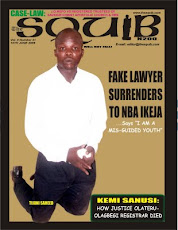
Vol 8 No 18 25th Feb 2008- Lawyer in Soup: Docked Over Forgery of Court Document


LAWYER IN SOUP – DOCKED OVER FORGERY OF COURT JUDGEMENT
It is not a common sight to see legal practitioners in the dock of a court room. Their favourite perch is at the bar, pleading the cause of their clients and earning their fees. However, a legal practitioner, Obiorah Umeh Esq. forty-three years old had cause to face a court of law, on January 29, 2008 from the centre of the dock as an accused person. That court is Magistrate Court 3, Ikeja.
Alongside one Mr. Daniel Nwarienne, the barrister was arraigned on a three count charge of conspiracy to commit forgery, forgery and willfully making false claims in Charge No. MIK/C/06/2008. There are two immediate striking aspects of the case. First is that Obiorah Umeh’s co-accused is a client of the lawyer and secondly what the duo allegedly conspired to forge and allegedly forged was, of all things, the judgment of an Ikeja High Court in favour of Daniel Nwarienne delivered in April, 2007 (See cover story exhibit).
In that case, Suit No. ID/165M/2004: Daniel Nwarienne & Or Vs IGP & 6 Ors. Honourable Justice O.H Oshodi found that the defendants (except the 3rd) had violated the constitutional right of liberty of the applicants and awarded the applicants the sum of N100,000 jointly against the 1st 2nd 4th 5th 6th and 7th defendants jointly and severally.
Unbelievably, this happy development was to lead to unhappy consequences for the 1st applicant in the suit, Daniel Nwarienne and his lawyer Obiorah Umeh. Inner sanctum geckos informed the squib that several months after the judgment in the suit was delivered, precisely on the 25th day of January 2008, a certain barrister turned up in Honourable Justice Oshodi’s court requesting to meet with the registrar. The gentleman barrister was not Obiorah Umeh Esq. but he said he had come to verify and certify a judgment of the honourable court in Suit No. ID/165M/2004.
The registrar who attended to him straight away noticed that the copy of the judgment in question brought out by the lawyer had a signature different from that of his boss, Oshodi J. When he told the lawyer his observation, the lawyer demurred claiming that there was nothing wrong with the judgment in his hand. The registrar however insisted on his point, a position which irritated the lawyer greatly. The argument soon became loud and then hot since neither the registrar nor the lawyer would yield ground. To the greater annoyance and bewilderment of the lawyer, the registrar upon closer perusal of the judgment found that the sum awarded in favour of the applicants was five million naira!
If the registrar was in any doubt before that the judgment the lawyer brought was ‘genje’ (fake), such doubts vanished immediately. Yet, the lawyer insisted that the registrar’s claim could not be right. At that point, it was decided that the best thing to do in the circumstances was to draw the attention of Honourable Justice Oshodi to the situation. When this was done, the judge, stared in the face with the brazen forgery of his order and signature wasted no time in bringing in the police. The police arrested the lawyer who appeared, and to some geckos trully embarrassed and very bewildered at the turn of events. According to out-field geckos, the lawyer explained to the police that he was innocent of any crime, as according to him, the document he came with was given to him by Mr. Daniel Nwarienne. According to the man, Nwarienne had told him that the judgment in turn was given to him by Barrister Obiorah Umeh, his lawyer in the fundamental right suit before Honourable Justice O.H Oshodi.
The police allowed the lawyer to put a call to Nwarienne who he asked to come to the police station to clear him, since he was only helping him (Nwarienne) certify what he believed was a valid court judgment in his favour.
At first, the police doubted whether Nwarieene would show up. But the man came and was promptly arrested. When he corroborated the detained lawyer’s story, the lawyer was eventually let off the hook.
But another lawyer was soon to replace him in detention - none other than Obiorah Umeh. At the end of their investigations, the police believed that both Nwarienne and Umeh are culpable of forging the judgment of Justice Oshodi and had a common intention to achieve that end. Upon his arraignment before the court of law, Barrister Umeh was granted bail by the court. Unfortunately, the gentleman stayed for some time at the Government Lodge, KiriKiri, eating the ‘king’s rations’ before his bail was perfected. The next hearing date of the case is 26th of March, 2008.

Tuesday, February 19, 2008

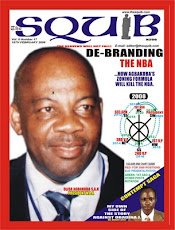
Vol 8 No 17 18th February 2008 'DEBRANDING THE NBA'


DE - BRANDING THE NBA – EXPOSING THE MAKURDI NEC AGENDA OF AGBAKOBA S.A.N
If the present leadership of the Nigerian Bar Association have their way, elections into offices in the association would never be the same again.


In the association there are fifteen “National Offices to wit - president, 1st Vice - President, 2nd Vice - President, 3rd Vice - President, Secretary, 2nd Assistant Secretary, Treasurer, Financial Secretary, Publicity Secretary, Assistant Publicity Secretary, Welfare Secretary and Legal Adviser.
Before 1998, the elections into these offices were General, that is, all interested members of the association were eligible to vote for all those eligible to contest in any of the offices.


However, after the protracted crisis that plagued the NBA for six years following the scuttled elections in 1992, in Port Harcourt, Rivers State, the general nature of the plebiscite was changed to make the elections a delegate one. Under this arrangement, voting is carried out by accredited representatives (delegates) from each of the branches.

Another fall out of the 1992-1998 crisis was the emergence of political regional/tribal blocks in the Association. Hitherto, the main divide was along ideological lines, the so called progressives (or activists) and the conservatives. Some watchers and historians of the lawyers’ association believed that the emergence of WAZOBIA formations i.e. North, East (South) and West in post 1998 NBA was due to the perception in some quarters that one of the causes of the 1992 crisis was the overbearing influence of westerners (South - West lawyers, mainly Yorubas) in the leadership of the NBA. According to members of that school of thought, majority of the past leaders of the NBA were Yorubas, a development said to be upsetting to other groups, particularly Northerners, notwithstanding that, Western Nigerians were exposed earliest to Western and legal education and were vastly more in numbers in the law profession especially in the 50s, 60s, 70s, and even up till the 80s than other groups of Nigerians.

The concomitance to the emergence of regional/tribal blocks was the emergence of the idea of rotating the prime leadership of the bar, to wit, the presidency among these groups, so that contest into the West would no longer become an-all-comers’ affair. However, another school of thought believed that the idea of rotating the presidency of the NBA ironically was started and championed by the Western regional group under the auspices of the unrepentant irredentists group - Egbe Amofin Yoruba, based in Ibadan, under the leadership of Chief Bamidele Aiku S.A.N went, for cheap political gains and immediate narrow calculations. It was the Egbe leadership in 2000 who negotiated with the leaders of the Eastern Group that, it should be agreed that if Wole Olanipekun S.A.N, a Yoruba and a leaders presidential contestant should step down for O.C.J Okocha S.A.N, an Easterner so to say, then the presidency should go to the West in 2002 and the North should have it 2004.

In the 2000 presidential election there were only three contestants – O.C.J Okocha, Wole Olanipekun. Both Onakoya and Olanipekun are Yorubas. At the end of the day, Olanipekun stepped down and out of the race while O.C.J Okocha went on to defeat Segun Onakoya and become president.

In the 2002 elections which took place in Ibadan, the contest was only between two persons, Onakoya and Olanipekun again, both Yorubas. Olanipekun roundly defeated Onakoya with over whelming support from the East and the North which had apparently bought into the Zoning Formula.

Consequently the 2004 presidential elections, had three of the four contestants as Northerners, to wit Bayo Ojo (Kogi) J.B Daodu (Kogi) and A.B Mahmond (Kano). The firth contestant was an Easterner, Philip Umeh, the Former Secretary - General in 2000-2002 under O.C.J Okocha. The outcome of the election was that Bayo Ojo S.A.N, though a Yoruba complied as a Northerner, while Philip Umeh not only came out last but being an Easterner was derided as an odd man in the election. If the 2004 elections left any one in doubt that the “Zoning Formula” is now an active reality in the NBA, the 2006 elections dispelled any such doubts.

In the 2006 contests, there were only three contestants: Olisa Agbakoba S.A.N, Chris Uche S.A.N and Funke Adekoya S.A.N. Funke Adekoya, a Former 1st Vice – President of the Association and obviously good leadership material came a dismal third position essentially because she was perceived as flying against the arrangement amongst the Regional/Tribal blocks that in 2006, it was the turn of the Eastern Region to produce the president of the NBA.

Before Olisa Agbakoba, the winner of the 2006 presidential contest came on board he had during his campaigns stressed vigorously severally that he would re-organise or revarying the NBA as a professional to make it much more dynamic, efficient and more modern. He had a beguiling catch-phrase for this all important project of his – RE- BRANDING.

Unfortunately more than half through with his tenure as leader of the NBA, the much touched re-branding of the NBA promised by the man dubbed by this magazine as a “ velvet activist” way back in 2006, has not happened. In failing to achieve the amendment of the constitution of the NBA that would pave way for the much advertised administrative wizard in form of Chief Executive officer for the association the NBA has not undergone any in rotating only the presidency of the NBA among regional/tribal groups, Agbakoba is very much interested in extending the rotation virus to half of the available offices of the NBA.

The road to the implementation of this objective started in earnest at the 2007 November NEC meeting of NBA Maiduguri where a guided and depleted NEC allegedly adopted the “policy of inclusion in relation to election of National Officers.”

After the alleged adoption of “inclusion policy” the softer language for zoning formula, by the NBA NEC, the NBA president constituted significant and positive administrative overhauling under Agbakoba. Any changes in the administration of the NBA has only superficial, tangential and a more out – fitting of existent positions to Agbakoba’s tribe of loyalists and followers. Curiously, Agbakoba who many used to take for an activist or even a subscriber to radical politics appears determined to rebrand the NBA by debranding as a Nationalist Organisation and making it an association where leadership opportunities are to be shared out more on the plat forms of regionalism arm tribalism than on merit. While his post 1992 predecessors in office were only content aid wrongly too, a 25 - man Commitee to work out the modalities of actualising the policy.

At a meeting held on 5th December, 2007 in Abuja, the Abudullahi Ibrahim SAN inclusion policy committee resolved that

(a) there will be six (geo-political) zones in the NBA for the purpose of elections

(b) Six out of the fifteen offices in the NBA at the national level would be open to rotation among the six zones.

(c) the 6 affected offices are President, 1st Vice – President, 2nd Vice – President, 3rd Vice – President, General Secretary Assistant General Secretary.

(d) The ‘Inclusion Policy’ will start from 2008. The West will take the Presidency.

See Chart I (2008)

(e) The Presidency alone rotates anti clock wise while the other five posts rotate clock wise on the given chart

(f) Where a post zonal to a particular zone, the zone may adopt a member of that zone as their preferred candidate even where such a person works or lives outside the zone.

In setting up the Abdullah Ibrahim Committee, the president issued them what he called a working paper, authored by himself. In the working paper, Agbakoba asserted without any arguments whatsoever that the Inclusion Policy would help make NBA elections more professional, less expensive and less tedious, as well as make the NBA grow.
Critics of the Inclusion Policy do not share the rosy views of the NBA President and many are determined to come to the Makurdi meeting to scuttle the Inclusion Policy. The first criticism against the Inclusion Policy as firmed out by the Abdullahi Ibrahim Committee is that it is too extensive, affecting as it were a whopping six offices, with the effect that very many aspirants into the offices in the miniature 2008 elections are already locked out.

For example, under the Inclusion Policy, any South Westerner interested in contesting for the post of Secretary of the NBA would have to wait for the year 2012 to hope to actualize his dreams, while in the same year 2012, no candidate from the North Central can even contest in any f the six zoned offices.

A longer look into the prescriptions of the Committee can only yield more distressing discoveries. Undoubtedly, if the Inclusion Policy of Agbakoba is accepted or forced on the association, the policy can only serve to promote balkanization of the NBA along tribal lines, while promoting and glorifying nepotism based on tribal or regional sentiments above quality and merit, since otherwise competent candidates are excluded from certain electoral contests because their organs made them presently ineligible.

It is also feared that the Inclusion Policy will necessarily demoralise otherwise active members from purposeful contribution since their individual yearnings to serve must first of all be conditioned to an artificial appropriate time allocated to them to present themselves for service, which oft times would differ from when they are actually ready and willing to serve.

How the Inclusion Policy will make the NBA elections less expensive and easier to run remain a baffle to the critics. This is because under the policy, candidates would still need to be voted for by voters outside their zones and so would still need to criss-cross the various zones and branches in search of votes.

Critics also wonder what informed the choice of posts adjudged fit to be zoned and those adjudged otherwise. For example, could it mean that an office such as that of the 1st Assistant Secretary-General slated for zoning is more important than the Financial Secretary, Welfare Officers, Publicity Secretary, Treasurer etc!

As far as this magazine is concerned, the Inclusion Policy of Olisa Agbakoba S.A.N is an ill-wind that will bear the association no good in the immediate, near and far future. It is too artificial, unnecessarily, complicated, narrow, undemocratic, schism promoting and merit denoting to be allowed to stand.

If the seemingly innocent “zoning formula” patented by tribal and regional irredentists in 2000 can grow to a monstrous dimension of ‘INCLUSION POLICY’ just eight years later, one wonders what destructive ogre the INCLUSION POLICY of Agbakoba would have turned to in 2015.

A professional Nigeia ought to be forward looking and show the way in what binds us together as Nigerians and not what highlights our differences.

Let those who have ears hear!

Thursday, February 7, 2008

"The Death of Baba Kess"


KESSINGTON J., JUDGE MOST UNUSUAL, PASSES ON

On 30th January 2008, the earth opened one of its uncountable months and swallowed up the remains of Abiodun Nuraini Kessington in far away London, United Kingdom. Kessington a retired judge of the Lagos State High Court was born on the 6th April 1932 in Lagos.

From all indications, it was a quiet burial for the late Judge in London. If the event had taken place in Lagos his home town, the burial certainly would have attracted quite a large turn out of friends, relatives and sympathisers, particularly from the legal profession.

Kessington I never became the Chief Judge of his state and spent only seven and a half years on the Lagos Judiciary, yet he lived and died a legend of sorts.

Born in Lagos, young Kessington, had his secondary education in Port-Harcourt from 1947-1950. He later had his legal training at the Holborn College of Law and Commerce, University of London and was called to the English Bar, Middle Temple, in December 1964. In 1966 he was enrolled as a Barrister and Solicitor of the Supreme Court of Nigeria.
After working for six years as a Prosecutor in the Compliance Inspectorate of the defunct National Provident Fund (1967-1973) as a State Counsel, Kessington Esquire (as he then was) joined the Rivers State Ministry of Justice as State Counsel and remained there until 1982.

In 1982, Mr. A. N Kessington reported to the Lagos State Ministry of Justice as Assistant – Director Public Prosecutions. According to the man himself, he was frustrated out of the service of the Rivers State Government, when the authorities refused to appoint him Director Public Prosecutions, Rivers State because he was not an indigene of the State.

Intelligent, brash, extremely extroverted and industrious, it was not long before the Kessington persona become known at the Ministry of Justice Lagos. The Squib spoke with two of those who worked with the late judge in his time at the Ministry of Justice and both were full of superlative praises for “Baba Kess.”

According to Mrs. Tola Akinsanya now a director in the Ministry of Justice Lagos, Kessington was a model boss who knew how to get the very best from his subordinates. Said Akinsanya: “I was very sad to learn of his (Kessington) death. He was such a wonderful man. He was very plain, had no pretences and was very approachable. He was not like some bosses, subordinates could only relate with him formally and officially. Kessington was not like that. You could go to him with any problem at all and he would do his best for you. He was always encouraging us to continue working hard, despite our little pay.

He was also very hard-working and intelligent. He taught us how to work with dispatch. Under Kessington no case file can stay on your desk for a week. And one other thing; he loved to help the down-trodden, the under privileged. I remember a time when the police was in the habit of arresting people at bus-stops for no just cause and charging those who could not ‘settle’ them to court for ‘wandering.’ There is a name they used to have for it – “Roger” or something. One day Kessington went to town in disguise and stayed at a bus- stop. He was arrested by some policemen. It was at Pedro Police Station Somolu when they were negotiating his freedom with him, that somebody noticed that the victim was the DPP Lagos!”

Another director at the Ministry of Justice, Mrs. Efunbo Gbadebo, also a Former Director of Public Prosecutions, shared Akinsanya’s sentiments on Kessington J. According to Gbadebo “Kessington was a jolly good fellow, erratic though but lively and very willing to impart knowledge to younger people. He was a very good man but people misunderstood him because of his tomboyish nature. He would never allow younger counsel to be cheated or oppressed by anyone. Any time you greet Kessington he would answer thus, “Olorun wa O! (literally, Eh, God is watching you).

His friends cut across all levels - the mighty, the middle class and the lowly. As for brilliance, he had it. He had the Evidence Act on his finger tips and was a Master of Criminal Law. Very jovial, he was an “agbalagba Omo ta.”

Credible information has it that it was not easy for Kessington to cross from the bar to the bench - some V.I.Ps considered him too obnoxious a fellow to merit a place there. But Kessington, due to, some say, connections with the military (which was in power then) got elevated in October, 1989.

It was not long upon becoming a judge that counsel and litigants knew that a sharply different type of judge had come to the “Throne of Judgement.”

A loquacious, impetuous, brutally frank, even irreverent, albeit intelligent judge, Kessington became known as a “peculiar mess.” He appeared to detest the haughtiness and the urbane pretentiousness of many legal practitioners and took a special delight in tearing away at any pomposity in wig and gown.

On the Kessington style of adjudication, a very senior counsel at the Ministry of Justice, had this to say:

“Kessington did not like to waste time and wanted justice done. So he went straight to the heart of the matter at hand. If for example there was a case of indebtedness before him he would not have time for lawyers’ talk and legal finesse. He would just ask the defendant:
"Hen, hen Mr. man are you owing?" If the man answered in the positive, Kessington would now ask him, "when and how are you going to pay?"


There are very many stories about the antics, or do we say “performance” of Kessington as a sitting High Court Judge - how he could recite the whole of Evidence Act off hand, how he regularly poked fun at Senior Advocates of Nigeria, whom he used to dismiss as “San-San,” how he almost sent the revered legal colossus, the late Chief F.R.A Williams S.A.N to prison for contempt, his open love and admiration for Chief Fawehinmi, then a Junior Advocate of Nigeria, his rancorous quarrel with his Chief Judge, Ligali Ayorinde, whom he threatened to beat up, his contempt for lawyers that came to his court poorly prepared; but two of the numerous stories, adequately portray the true figure of Kessington as a judge.

It was in 1993 and Kessington J was hearing a divorce case. The husband was the petitioner and the wife, the respondent. The petitioner was asking for the custody of the only fruit of the union, a boy. The wife filed her reply, opposing the petitioner’s prayer for the custody of the boy, on the ground that he was not the child’s father. In her affidavit, the woman claimed that while still living with the petitioner, another man impregnated her, resulting in the boy.

Kessington J, called the parties and their counsel to his chambers. Waving the respondent’s affidavit, the judge accused her of being a wicked woman who wanted to destroy the future of her son by swearing to such an affidavit. Then in front of everybody the judge unabashedly started to weep! Amidst his tears, Kessington asked the woman.

“Why did you do this? God will punish you. Is the fu…g you were having that intoxicated you so much, that you put your stupid act down on paper in court? Don’t you know in the future, when your son wants to attain a lofty height, his opponents can get hold of this affidavit and ruin him?

After gaining a little control of himself, Kessington advised the woman to file a new affidavit to replace this “bad one which I will personally destroy.”
Despite Kessington’s urgings, the respondent refused to withdraw the counter-affidavit. Kessington J now sent the case file to the Chief Judge who sent it back to him and ordered him to continue with the hearing of the case.

But Kessington J would do no such thing. Before adjourning the matter sine die, he declared:

“I am an African man I will never be a party to the destruction of families. I am adjourning this matter till when Jesus comes back. Since it is about 2000 years now, they’ve been saying he will come back and he has not done so, you know what that means.”

On another occasion, Kessington himself disclosed to a group of lawyers thus:

“You see one day two brothers were fighting over a piece of land, and the case to my court. I know both of them from childhood. Then the elder approached me to grant an ex-parte injunction against his brother, I did but the younger brother did not obey my orders not to enter the land. He said Nuraini cannot send me to prison, we used to drink beer together. Then his brother came back to ask me to commit his brother to prison for contempt. I told the older brother, you are mad. So it is me that will send your brother to prison? And later his children will see my children and say it was your father who imprisoned our father? Please, if you want him in prison, better pack him there yourself! Get a wheel barrow and dump him there by yourself!”

Abiodun Nuraini Kessington is dead. He died an imperfect man. Nobody is perfect. He had his foibles. He made his mistakes. But essentially he was a justice-minded judge.
May his jovial and kind soul find peace with his Maker. Adieu, “Baba Kess.”

Wednesday, January 30, 2008

'I cannot be used for any evil' M.O. Abubakar, CP Lagos State


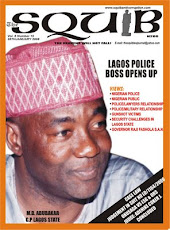
On 11th January, 2008, the honourable Commissioner of Police, Lagos State, Mr. M.D. Abubakar granted the Squib a seventy minute long interview. The interview which took place in the Commissioner’s office showed an ebullient, forthright and a rather intellectually disposed cop in the officer. He spoke on his long career in the Nigeria Police which started in 1979 and discussed his organization passionately vis-a-vis society and government amongst other things.


A widely traveled man, Commissioner of Police Abubakar at the end of the interview did not appear to the Squib as one of the run of the mill senior police officers. This magazine wishes him the very best in his latest assignment in the Nigerian Police. Please read on. Below are the excerpts.

SQUIB: Good evening sir,
C.P: You are welcome.
SQUIB: Sir, you are the latest Commissioner of Police for Lagos State. Can we know a little about you?
C.P: MD Abubabar is my name. Born 15th May, 1960. Studied Criminology and Criminal Justice Administration {Masters Level} at the University of Lagos. I did Marketing. I did Public Administration. I did Political Science long time ago.
SQUIB (cuts in): As an undergraduate?
C.P: Yes. I’m from Gusau, Zamfara State. That’s my town. I de-emphasize the state where I come from because I believe in the unity of Nigeria. I am a member of the National Institute of Policy and Strategic Studies [NIPSS] Kuru, Jos. I am a fellow of the Nigerian Chartered Institute of Economics. So, because I believe in the unity of Nigeria, that’s why I usually say I don’t have a state. I think Nigerians should work hard and co-operate so that we will look like other countries of the world.
SQUIB: Before you became the Commissioner of Police Lagos State, what was your career path like?
C.P: Well, you see emm… after I passed out, I worked briefly in the State CID at Markudi, that was my first location. After one year; I went to Scotland Yard in England.
SQUIB: When was that?
C.P: In 1982. I was privileged to go to the Metropolitan Police College in England and the Malaysian Police College where I did the MPF training (Mobile Police Force) in 1983. I was in Kebbi before I moved on to the Intelligence Department, we call it CIB (Criminal Intelligence Bureau). While at the CIB, I went to a Polytechnic in Cairo in 1986. I attended courses in Welshfield and Yorkshire in England. Then I went to Israel Command Force in 1996. I equally have a Diploma in International Business Management, also from Israel. I went to the Federal Bureau of Investigation [FBI] Department in United States. Then from there, I was growing through the career.


In 1991, I went for an international security course in England that took me to eleven countries of the world. When I came back, I was posted to the rank of an Assistant Commissioner of Police, CID in Sokoto. I attended my regular police training at the Police Staff College; A-course, B-course, Intermediate Command Course and Command Course at different intervals. Then in 1993, I came back to Lagos. I was an Assistant Commissioner of Police in charge of Federal Operations, Force Headquarters, Kam Salem House. From there, I was posted to the Murtala Mohammed International Airport (MMA) Ikeja as Airport Commander also in 1993. By virtue of my position as Airport Commander, I had the opportunity of traveling to most airports of the world to do Security understudy in terms of the security of the airports. Then, I became the Deputy Commissioner of Police at the airport.


I was promoted in the year 2000 and was transferred to Plateau State as Commissioner of Police. I was CP Plateau, Abia, Kwara and Kano States. I came back and became CP, MMA Airport again because when I was at the airport, I was writing proposals that the airport should be upgraded to a level of a command in view of the nature of what I saw and taken into consideration acts of terrorism, normally a threat to most airports of the world. I can say I am glad and very grateful to the almighty God for being with us. Some of my colleagues don’t have the opportunities to do that.
I can say without doubt, I have commanded the most populous states in Nigeria (Lagos and Kano). Lagos and Kano are the most problematic, most difficult and most challenging states in Nigeria.

SQUIB: How do you mean most populous, most difficult?
C.P: Lagos and Kano are the most populous states in the country; most challenging, most problematic and most complex. You know when I say most challenging, it is in the sense that population is a determining factor that has to do with crime. Because in the area of unemployment and high level of poverty, you know what that means to the society. So you have the contending role of ensuring that those who are not employed do not infringe on other people’s rights by taking their properties, harassing or molesting them.

Let us take for example the issue of traffic, the volume (both human and vehicular) in Lagos and Kano. I think these two states can share the highest volume. Today, Kano has 44 Local Government Areas even after Jigawa State was carved out of it. From one LGA to another, you can spend up to 4 hours to drive there! So big.

Any day, Monday through Friday, you will be wondering where the human beings are coming from. One of my friends once said whether they are being dropped from upstairs. Because, the kind of the situation in Kano is the same with that of Lagos. And I say challenging because you can see the challenges you have in Lagos. Area boys scourge alone is a problem. For you to be able to tackle the problem of area boys, for them not to harass, molest anybody and you want them to go and sit down doing nothing when they have no food to eat and have no shelter, is really a challenging one. And they (Lagos and Kano) are equally commanded by the largest number of police force in terms of personnel. I am having about 28,000 policemen (officers and men) in Lagos State and there is no other state you can compare with Lagos.

If you look at the policemen, for me to be able to control them, let alone talk of the 17 million people that are in Lagos State. It’s a very challenging task. It’s not the Lagos State that we used to know in the ‘70s. Look at the expansion of Lagos. Take for example, a drive just from old Maroko towards Epe. Left, right and center, you have hundreds of estates coming up from this axis. Some people, if you ask them about the location of Langbasa in Lagos State, they don’t know where Langbasa is. You come back to look at places like Igando. Igando used to be a very remote, bushy area that you find nobody but now it’s a city densely populated.

SQUIB: How do you cope? How does the command cope under you?
C.P: Well, that’s why I say it is very challenging. It is not an easy thing. We thank God for giving us the ability and capability to put up our best. But we leave the rest to the people to decide whether what we are doing is right. We are only doing everything humanly possible to do our best because when I took over the mantle of leadership of the Lagos State Police Command in June 2007, having known what the command is, and having spent many years of my career here, I know what Lagos is all about and the knitty-gritty of fighting crime and vis-a-vis the fighting tools we have. They are there but not adequate enough when and where you want them. Happily, we have seen a government that is responsible enough to respond to the yearnings of the people. Mr. President is doing wonderfully well. I can’t say otherwise.

SQUIB: What about the State Government?
C.P: The State government is doing very well also in terms of providing adequate equipment. You see, when you have individuals driven with passion for safety of lives and properties, then they are committed and that’s the only way you can describe the Governor of Lagos State.
And being a lawyer, he has no option than to do well. I think being a lawyer, there is no option than to do what he is doing. He is an individual beside being a lawyer who has love for his people otherwise he wouldn’t do what he is doing and I think there is no state in this country that has done what he has done so far.

SQUIB : How do you mean?
C.P: All along, he went to convince and got the support of corporate bodies and individuals to put up like 250 vehicles at a go, costing over several millions of naira. I don’t know of any state that has done this. I stand to be corrected, Governor Babatunde Raji Fashola is doing great, perhaps others will follow in this direction. Police is an agency of the government. It is not a partner in that government. Whether it is a state or federal government, it is their responsibility to provide the tools for the police to use. That’s why you hear police are not being well paid, the police are not doing this or that.

The first important thing is what have they got to perform that function? For example, you can’t take a child to school without books, without writing materials and you expect him to write and you expect him to read without textbooks and also expect him to pass his/her exams. It is practically impossible. So, we are making do with what we have and this is the first time you can see they are responding to the situation of the people. More arms and ammunitions are being bought. If you look at the challenges, he (IGP) knows where the shoe pinches. The IGP knows where it pinches and he took up the challenges and we are quite happy with what is happening and he has taken the welfare of the Nigeria Police seriously.

SQUIB: Are you saying, the Police are now being well remunerated/better paid?
C.P: Security is very expensive these days. Nobody can quantify the level of security and ever pay you adequately for what you have done. I stand to be corrected. But you pay somebody a living wage, something that will make him cater for his family, pay school fees, take care of his children, feed his household and live comfortably. But if you want to quantify what he has done and you want to pay him, it is practically impossible. Mathematically, you can’t do that!

SQUIB: Can we say the Police are now having a living wage?
C.P: We are transcending to something close to that.
SQUIB: If I may ask you, sir, the average Nigerian sees the police as being not his friend, as somebody, to be feared. They see the police as a bully, somebody who should not be assisted because if you help the police, you are in trouble or could be in trouble.
C.P: I think it is not true and would be frank with you. One of the reasons for this perception is:
{a} Probably, you had an encounter with the wrong policeman.
{b} Nigerians are very gullible persons and like breaking the laws and want to go scot free. An example is driving against one way and a policeman stops you, then you say I am Mr. so and so. Then the policeman says you are going to the station. The policeman is strictly doing his job.
{c} Another typical example is that most Nigerians encourage policemen to do some of the bad things they practice. The government has the responsibility of building police stations and giving all the necessary equipment to the police to work. But this does not happen. Then therefore, say for an instance, there is a DPO and somebody from nowhere walks to a police station, introduces himself under the banner that he wants to assist the police asking why the police station is like this? Why are there not enough facilities and equipment? Then he dips his hands into his pocket and brings out two to three hundred thousand naira and gives the DPO. The DPO will be very happy or he gives the DPO the money to buy files for the police station. The DPO collects the money.

About three days later, the same person walks to the DPO. The DPO will even prostrate to the man to appreciate his kind gestures. The man then tables his problem before the DPO that he has a brother or somebody in the DPO’s custody and he tells the DPO that he knows his brother and that his brother can’t do such a thing as he was being accused of. Perhaps, his brother has committed robbery and the police do not have evidence to prove such a case. Based on his earlier humanitarian gesture, the DPO releases the criminal brother to continue robbing. The DPO has been lured to do what he did. If the government gives all that is required, you won’t have that happening.

An ideal police station should have 8 vehicles but a situation where there is only one vehicle to a police station and there happens to be 2 distress calls almost at the same time, which one should the police attend to? Whose fault? The same thing applies to a fire brigade fighter. There is a fire outbreak and when he gets there he opens the nozzle but there is no water. A distress call comes to a police station and the policemen say there is no vehicle, then the caller bangs the phone saying old story again. His expectation is that the police should be adequately equipped 24 hours to come to his aid. Nonetheless, the police is trying its best in the circumstances. I stand to be corrected, it is only the Nigerian Police that fights corruption in this country, the way corruption should be fought!

SQUIB: How?
CP: It is only the Nigerian Police that arrests its own personnel for wrongdoing. If he is arrested, he is detained. He is investigated, and if found guilty, is dismissed and prosecuted. Is there any other organisation like the Nigeria Police that fights corruption?
Sometimes in this country, people were being shot for carrying cocaine. Did they stop? They never stopped. People are being shot for armed robbery, it is still goes on. You and I know clearly, it is part and parcel of the society. Once society exists, crime must exist no matter how small it is. And we are not going to be tired; but I tell you that there has been serious reduction in forms of bribery and corruption in this command, and even with the coming of the Inspector General of Police (IGP), there has been serious reduction in crime and you can see the level of change in our policemen in terms of their behaviour and character while on the road. Because once they realize that the leadership does not tolerate it, they run away. It is a leadership problem. Once you have leaders who say; No, I don’t want this or that, you have to do what is right otherwise, you will be shown the way out. They will perform excellently well.

SQUIB: Can you tell us what the relationship between your command and the military is?
CP: Well, so far so good, we have an excellent relationship in this command with the military, we exchange ideas and relate very well. We interact very well. We go for meetings where we sit down together. We have never had any problems.

SQUIB: Have you heard if their personnel have ever beaten up your men?
CP: Since I came, I have not had that experience, not even once. We have had instances of the military handing over men involved in criminal activities over to me.
SQUIB: By themselves?
CP: Yes. So, that is to tell you the level of cooperation we have. It is excellent. For now, it is excellent. We have never had any cause to break that cordial relationship. I know the Brigade Commander, Gen. Maitama Yussuf, a very fine officer. The Airport Commander is excellent. Also, the Naval Commander. We have excellent officers’ relationship. Look at the issue of the merchant navy, we just took over the merchant navy and they handed over the case to us because they know their limitations. Cooperation we should have. And it goes well. And we have meetings we go to, sit down, exchange ideas, and do things together. That’s how it should be.

SQUIB: What about this problem of hospitals (doctors) getting clearance from the police before they can treat patients with gunshot wounds?
C.P: You mean you have to first and foremost get a clearance from the police before you can be treated? It has changed completely because we don’t have such problems now. Most of the time, people go to the hospitals before police stations. They are treated without the police even if the person is an armed robber. The first thing you can do is to treat him first because we don’t want him to die. We want him to sit down and give us information about who he had killed, where he killed and where the arms and ammunitions were. Things have changed. We don’t have problems with that at all.
SQUIB: Sir, Police and lawyers, it’s like a cat-dog relationship? What is the problem? Sometimes, policemen maybe hostile to them and your policemen see lawyers as being arrogant. Sometimes lawyers come to the police station to seek bail for their clients, but you hear policemen tell the clients, “instead of settling the case you have money to hire a lawyer, who told you to bring a lawyer and lots of things like that.” As an experienced police officer, how do you see these issues and what advice do you have for the lawyers?
C.P: I think it all depends on the level we relate. What matter is the understanding of ourselves knowing the role of the lawyer and what he is supposed to do. Some policemen don’t know. Some do and some are not worried at all. I have interacted with the NBA in Lagos State. Since I came to this state, we have exchanged ideas. For us to have proper co-ordination, I appointed a liaison officer so that he will be able to relate with Nigerians. I took it as a point of duty to lecture all my DPOs and Assistant Commissioners to ensure that what we do is right. Tell them what to do and how we expect them to behave at all times. Everyone has the right to come and see anybody that is detained at the police station, that’s the provision of the law. The investigating police officer (IPO) can be there. If it is within the police powers to grant bail at the police station and if it is a bail-able offence, it will be so granted provided it will not jeorpardise further investigation.

Lawyers are supposed to be working with the police and the judiciary. The police see to it that justice is done. Some lawyers understand. For instance, if somebody or a client comes to you (lawyers) to tell you a story of land matters, landlords and tenants issue, instead of you (lawyers) to take the case to court and charge him your professional fees and do what is right. You will rather want to use the police. This is unacceptable and we need to do more. We have responsibility to do more. If the lawyers and police work together, it is for the benefit of the citizens of the country.

One, you have left trivial and minor cases out of court. Two, you have left civil matters, all these civil cases (landlord and tenant) out of police stations. You have not paid the landlord your house rent as a tenant and you are rushing to the police for help. Or the landlord has locked your room because you are owing. These are cases that can be resolved ordinarily without going to court so that our courts can be left free to face serious cases. Lawyers are supposed to be crisis and conflict resolution managers just like the police. A lawyer can act as a policeman by his powers under the law, he can also make arrests just like any other person. By the wisdom God has given him as a professional, he should be able to sit down and advise his clients to follow the law and do the right thing. Some of these cases are very minor.

You see neighbours fighting over very trivial issues. You should separate them, because even if you go to court, and send the guilty person to jail, the person (offender) will still come back and live with the person who took the case to court, in the same house and probably go back to the same problem. Why don’t you make peace, because it doesn’t pay anybody to cause trouble. After paying the lawyer whatever he will charge, you are still going back to that same house.

SQUIB: If I may ask you, sir, MD Abubakar, why did you choose to be a policeman?
C.P: I think I have answered this question over and over again. I think I am destined to be a policeman by God. Do you believe in destiny? Yes, I do. Yes, I do because it is wherever you find yourself, you adapt. If I am not a policeman, I wonder where I would have found myself. That’s why I said I am destined to be a policeman. And I am proud of the Nigerian Police. Most people are criticising the police because they do not know the police. You and I know that several people don’t know what the police work is all about. What is the police salary? What and what it takes to be a policeman? How long it takes? What are the duties? What trouble does he go through?

There is need for you to appreciate a man’s job for you to be able to say whether he is doing the right thing or not. And for some people, the police is bad for the fact that the police do not allow themselves to be used by them. Tell me in this country, who doesn’t use the police either for good or bad?

SQUIB: Under your command, can the people use you?
C.P: Yes, legally, for good. Surely. But nobody can use me for evil. If you are doing what is wrong, you have to bear the consequences of your action. And there is a level you will be in the service, you just have to do what is right.
SQUIB: Are you saying if the Inspector General of Police (IGP) says you should do something that is wrong, you won’t do it?
C.P: My IGP will not tell me to do what is wrong. Sir Mike Okiro will not give me an instruction to do what is wrong.
SQUIB: He is a superior police officer, how can you tell your superior officer that you can’t carry out an order?
C.P: You can. Let me tell you, I have Area Commanders and Divisional Police Officers (DPOs).

SQUIB: Can they say No to you?
CP: Obviously, yes because I won’t give them bad instructions. They don’t work in my farm. The instructions I give will be legal instructions to do police duties. I will not tell them to release an armed robber without carrying out investigation. You can ask my DPOs whether I write such notes to them. If I write to any DPO, it is to say “Dear DPO, ensure justice is done.” I don’t give orders to do this or do that.
SQUIB: Sir, since the EFCC, am sorry to say, seem not to have a head for now, will you mind going their to head it?
CP: Don’t ask me about that. Well, I don’ want to go into that.
SQUIB: Nice to be with you sir.
CP: It is my pleasure. You are welcome.

Thursday, January 24, 2008

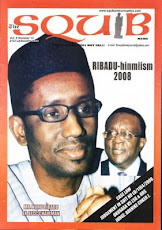
Vol 8 No 14 21st January 2008 'RIBADU-hinmiism 2008'


SQUIB COVER STORY

“RIBADU-HINMIISM 2008”

Since 2005, it has become a sort of ritual for the NBA Ikeja branch a.k.a Tiger branch or simply Tigers to host the public to a festival of ideas on the platform of FAWEHINMIISM, an annual lecture/symposium in honour of Chief Abdul Ganiyu Fawehinmi, a Senior Advocate of Nigeria, and arguably the most prominent human rights activists and social crusader in the last thirty years.


The lecture series started in the Adekunle Ojo chairmanship of the NBA Ikeja in 2005 ostensibly to honour the legendary Gani Fawehinmi, (renowned for his fearlessness, sacrificial patriotism, above all, untainted integrity) while still alive.

Since Gani as Chief Gani Fawehinmi is more popularly and simply known is not a quiet or silent achiever, but a colourful and rambunctious hero, it is natural that his celebration could never be done under the wraps.

Thus, from inception the FAWEHINMIISM Festival has always been an all comers event, with special efforts made to publicise the event, even before it took place and after it ended. To that end, advertisements in various media and forms of the events are done and journalists of all hues and colours cover the programme in their numbers.

A special tactic that guarantees attendance of many people at the festival is the announcement that the very first hundred guests to arrive would receive free, a number of Gani’s publications (law reports and books). This year, the number of beneficiaries of Gani’s benevolence was increased to 200, with each to receive 9 books costing no less than N15, 000.00.

Little wonder then that guests for the Fawehinmiism 2008 festival billed to start by 10.00 a.m. started arriving as early as 5.00 a.m. according to some reports. And by 7.30 a.m., three hundred and ten people were already on the queue to put down their names as participants.

Ironically, for an event organised and advertised as a lecture on ANTI-CORRUPTION, dishonesty manifested early as some people, lawyers inclusive were spotted shunting on the queue to ensure that they also had shares of the Gani freebies.

Fawehinmiism 2008 was different in one important aspect from the earlier festivals - the celebrant was absent.
In the 2005, 2006, 2007 editions, the presence of the lion himself, Gani, at the festival was a delight to so many. His style was to come to the venue quietly and invariably punctually. Then, he would go round humbly greeting and saluting distinguished members of the audience and very warmly too. Invariably, Gani was always the last speaker to address the crowd.

This aspect was what most people in the audience had come for - to hear the legend in that his unique and fascinating forceful manner, where he reels facts and figures so easily to back his contentions. Gani’s shortest speech at Fawehinmiism festivals lasted no less than two hours, and so passionately and emotionally delivered that even a corpse present could have woken up. Gani’s speeches at Fawehinmiism were not a matter of just of “sound and fury” but full of substance and penetrating insights into the problems of the Nigerian polity.

But at this year’s festival, the colossus was missing. The crowd (about one thousand, two hundred strong) was sorely disappointed to hear from Niyi Adewunmi Esq. the master of ceremony, who is also the chairman of the Organising Committee of the festival that due to ill-health, Gani had to be flown post-haste to the United Kingdom for adequate medical attention, just three days before the festival. It will be recalled that for several months earlier Gani, who will turn 70 in April had been battling ill-health in a London Hospital where he had gone for treatment. In fact he only came back home in Nigeria, to be around for FAWEHINMIISM 2008, but as the saying goes - “Man proposes, but God disposes.”

In the absence of Gani, his place was taken by another. That other person was not Gani’s charming and affable representative - Basirat Biobaku his daughter. Rather, it was his self-described protégé Nuhu Ribadu, Assistant Inspector General of Police, and until very recently, boss of the famous or is it notorious Economic and Financial Crimes Commission EFCC.

When the programme kicked off, the master of ceremony invited to the high table, Professor Bolaji Akinyemi the chairman of the occasion, Honourable Justice Olubunmi Oyewole {Special Guest of Honour}, Professor Akin Ibidapo-Obe, Mrs. Basirat Biobaku, Mr. Justice Morenike Onalaja, Professor Yemi Osinbajo S.A.N, Mr. Dele Adesina S.A.N, Mr. Segun Sango Aderemi S.A.N, Dr. Joe Okei-Odumakin, Adekunle Ojo, Barrister Adeleke, a law lecturer with the Lagos State University and the representative of the Dean, LASU Faculty of Law.

It would appear that there was an unconscious conspiracy among the dignitaries on the high table to make Fawehinmi 2008 more of a celebration of the controversial and publicity hungry Nuhu Ribadu, the immediate past chairman of the equally controversial - Economic and Financial Crimes Commission (EFCC).

Going by the theme of this year’s festival – “CHALLENGES OF LEGITIMACY IN GOVERNANCE AND THE WAR AGAINST CORRUPTION” a reasonable expectation was that lecturers and discussants would make their intellectual forays in the direction of discussing how corrupt acquisition of political power and authority would enfeeble any government crusade against economic and financial corruption in the polity.

Only a few of the speakers and discussants shared this perspective. Some delved more into the socio-political causes and consequences of corruption and gave advice on how the menace of corruption could be tackled while others took the lecture as an opportunity to revisit the already dead and buried controversy whether or not government did right in sending Nuhu Ribadu away from the EFCC as chairman to become an adult student at the School of Policy and Strategic Studies, Kuru, near Jos.

The chairman of the occasion was the first to go down the Ribadu lane. The Professor and former minister of external affairs, argued that since it is special individuals who build nations and who are remembered in history then, such special individuals are actually indispensable in the affairs of their nations, concluding that government was wrong in taking Ribadu away from the EFCC, an organ he had nurtured so well. As far as Professor Akinyemi was concerned, Ribadu was indispensable to the continuous growth and effectiveness of the EFCC.

The next speaker, Honourable Justice Oyewole steered a rather neutral course as he made his speech, an exhortation to the Nigerian masses to see the crusade against corruption as war to be fought by all.

After the Honourable Judge came Professor Yemi Osinbajo S.A.N. The revered lecturer dedicated his lecture to Nuhu Ribadu and that alone spoke volumes. Osinbajo pointed out that corruption is not only thick in the public sector of the economy but also in the private sector. Osinbajo, famed for his intellectual endowment contended that poverty and impecuniosity are the main causes of the social vices of bribery and corruption. According to the learned silk, under him as the Attorney-General of Lagos State, government made considered improvement on the welfare package or conditions of judges and magistrates to reduce their susceptibility to corruption.

Professor Akin Ibidapo Obe who spoke next traced the pervasive presence of corruption in the society to the abandonment of core cultural values and traditional, moral ethics of Africans. According to Ibidapo-Obe, Africans are not conginentally prone to corruption as some theorists contend, even though in modern times corruption is like a second skin to many Africans.
Just when Dr. Joe Okei Odumakin was about to address the audience, Mr. Nuhu Ribadu quietly walked in. The time was about 1.30 p.m. and the audience was immediately seized with a sudden fever of excitement as roars of applause greeted the entrance of the former EFCC boss.

Many in the audience, especially the law students and young lawyers became agitated. To them the presence of Ribadu was not only sensational but even magical. Even though the man wanted to stay quietly in the crowd, he was forced, so to say to the high table, and equally forced or held to ransom to address the audience.

Of course, Ribadu loved fewer things than addressing appreciative audience. Only last year at the Fawehinmiism 2007 where he participated as the Guest Lecturer, he had used the opportunity to display his ability as a grand-stander. The times have however changed. The political dynamics that governed his elevation to the EFCC top job had altered and he had been, as it were shoved “upstairs” and (at least for now), had become an ex-this as far as the EFCC is concerned. Thus, Ribadu embraced a new found taciturnity, although even then from the few words he spoke at the occasion to wit:

“When I entered into this gathering
I was impressed by the ovation given to me. That to me is a conclusion in itself, so to say. Anything now will be an anti-climax. Let us pray for this country.
I don’t want to talk in view of the prevailing circumstances. My silence itself speaks volume for what is going on in this country. Something is happening to our country.
I want you all to join hands to pray for this country. I leave everything in the hands of God” clearly indicated his bitterness and angst at his removal from the EFCC.


Of course Ribadu did not fail to express intense admiration, even adoration of his self-adopted mentor - Chief Fawehinmi SAN whose good health he prayed for.

Fawehinmiism 2008 was a natural and comfortable haven for A.I.G Nuhu Ribadu to express his views about Gani and in turn get applauded and lauded as a honest government official and anti-corruption fighter. This because, with the possible exception of speakers like Dele Adesina S.A.N and Profesor Yemi Osinbajo SAN, all the other contributors are ardent admirers and followers of the socio-political school of thought that Gani represented.

Speakers such as Dr. Okei- Odumakin, Segun Sango Aderemi, Olasupo Ojo etc. are Gani’s ideological tribesmen and so could not and did not provide any intellectual counter-foil to the credentials of a manipulating and ‘manipulable’ crime fighter like Nuhu Rabadu, who is seen by Gani and his ilks as faultless.

In all, at the end of day the event appeared to be more of a celebration of Nuhu Ribadu, certainly no apostle of strict compliance with legality and due process, than the absent Gani Fawehinmi SAN, who in his numerous battles with forces of political oppression had used and relied on the law and the courts of law as his main weapons. Certainly, Ribadu was the star of the event.

As the programme came to an end at about 3.30 p.m., Mrs. Basirat Biobaku, Gani’s daughter and representative thanked the audience for turning up to honour and celebrate her illustrious father.

Before the curtains finally drew on the programme, the organisers distributed books and law reports as promised to the “first” two hundred participants.

The SQUIB prays that Chief Fawehinmi S.A.N will be hale and hearty for many years to come. Fawehinmiism 2009, here we come!

Tuesday, January 15, 2008

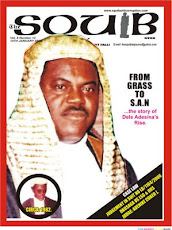
Vol 8 No 13 14th January 2008 'From Grass to SAN'


FROM GRASS TO SAN

On Sunday the 6th of January 2008, the Golden Gate restaurant played host to about a hundred and twenty people at a luncheon organised in honour of Mr. Julius Oladele Adesina, a Deacon of the Living Faith Ministry a.k.a. Winners Chapel. On the 12th of December, 2007, Mr. J.O. Adesina better known as Dele Adesina along with 16 other legal practitioners was formally conferred with the prestigious award of the Senior Advocate of Nigeria in Abuja. This achievement makes the new silk one of the very few senior advocates to hail from Ekiti and his very home town - Ilawe, Ekiti.

Billed to start at 2.30p.m., the programme kicked off some fifty minutes later. In attendance were about nine judges from the Lagos State High Court: Justices Coker, Oyewole, Oyefeso, Okunnu, Ishola, Oluwayemi, Obadina, a former Chief Judge of Lagos State, Samuel Olatunde Ilori, a Justice of the Supreme Court, Akin Oguntade JSC.

In attendance were also the leadership of the three branches of the Nigerian Bar Association in Lagos State to wit: Mr. Erastus Bola Baderinwa (Lagos Branch), Mr. Niyi Idowu (Ikeja Branch) and Mr, Nurudeen Ogbara (Ikorodu Branch).

Present also was the leader of the Living Faith Ministry - Bishop David Oyedepo who is also the Chancellor of the Covenant University. The Bishop’s wife - Faith was also present. Many indigenes of Ekiti State and Ilawe town were also present.

The Chairman of the occasion was Prince Julius Adelusi Adeluyi, pharmacist, lawyer and polygot while the Master of Ceremony was Barrister Adesupo Ojo - the Chairman of the Campaign for the Defence of Human Rights (CDHR).

The Chairman of the occasion gave a stirring address which was full of commendation for the celebrant of the day but he was surpassed by Bishop David Oyedepo who exhorted the new silk to manifest the greatness of his elevation in making himself more relevant to the progress of the society; even globally rather than seeking his own private enlargement and enjoyment.

The celebrant himself gave what was perhaps the most touching of all the speeches as he narrated the ups ands downs of his life, giving cogent examples of how people who could be described as strangers to him in the past, helped him up from a nobody to somebody.

His speech herein reproduced should serve as an excellent tonic to younger lawyers who are still struggling to make it in the legal profession not to lose hope and it can also serve as an encouragement for those who are already on the rise not to relent in their efforts. The SQUIB wishes Dele Adesina SAN, elbow grease!

SPEECH DELIVERED BY DEACON DELE ADESINA SAN ON THE OCCASION OF A LUNCHEON HELD AT THE GOLDEN GATE RESTAURANT ON THE 6TH OF JANUARY 2008 ON HIS CONFERMENT WITH THE RANK OF SENIOR ADVOCATE OF NIGERIA (SAN).

Ladies and Gentlemen,

It is a very great honour that you all both individually and collectively have done to me; my family and my Chambers by your honoured presence here this great afternoon, at this reception in my honour for my conferment with the prestigious rank of Senior Advocate of Nigeria. Let me admit straightaway that words are inadequate to express my happiness for this great honour. It is my prayer that my God will honour you all.

Let me assure you that, I am very conscious of the enormous responsibility that this recognition has imposed not only on me but also on all the 17 of us that were conferred with this great honour on the 30th day of October, 2007 by the Legal Practitioners Privileges Committee (LPPC) of our great and beloved Profession. This responsibility includes but not limited to an automatic assumption of leadership in the Profession. Leadership to show good example. Leadership in the defence and protection of the independence and integrity of the Judiciary. Leadership in the promotion of the welfare of both the Lawyers particularly the junior members and the Judges, knowing fully well that the greatness of any journey is a function of the quality of responsibility that a man engages, because responsibility they say is the price of greatness.

This enormous responsibility is of course in addition to our conventional role as Lawyers in a democratic society such as ours. It is to be recalled that the role of the lawyer in any democratic society is to consistently defend the truth and justice- It is to be a determined fighter for freedom.
It was Thomas Erskine who said that "it is the role of an advocate to break the rod of oppression and to ensure that the ordinary citizen is properly protected from power, its excesses, its misuse and its abuse". This is a role that is both professional and generational.

The world is looking for somebody who will do something not somebody who will explain why he did not do anything. I do not intend to fail the genuine expectations imposed on me by this elevation. As a Senior Advocate of Nigeria, I shall pursue justice, knowing fully well that justice does not flow from any system but from the individual.

According to all classical definitions, Justice should dwell in the hearts of men. Drawing grace therefore from those ahead of me, I shall not disappoint the purpose for my cherished elevation as a Senior Advocate of Nigeria.
In the book 'Purpose Driven Life", Rick Warren the Author, talking about sharing your life message had this to say "Shared stories build a relational bridge that Jesus can walk across from our hearts to others. Personal stories are easier to relate to principles as well as they are easier to remember for long". Peter the Apostle also said that "We are chosen by God to do His work and speak out for Him, to tell others of the night and day difference He made for us". In relating briefly how I got to this level, let me say that God is more than what people say. God is more than what people think and certainly God is much more than what people know of Him.

I was called to the Bar in July 1982. As a new wig, I was bubbling with life, full of high expectations, dreaming great dreams. After my NYSC, in an attempt to avoid roaming about in the wilderness of unemployment, having found nobody to link me up with a reputable Chambers for my pupilage in Lagos, despite my burning desire to work in Lagos, I joined the Ministry of Justice in Ondo State as a State Counsel in July 1983. Just a month after, precisely on the 16th of August 1983, there was a massive political violence that ravaged Akure the State Capital and some other major towns in the then Ondo State, following the gubernatorial elections of that month.

A friend of mine late Mr. Anthony Ayeni Akiika with whom I was squatting unknown to me was a strong supporter of the National Party of Nigeria (NPN)/ the party in whose favour the election acquired during my NYSC were burnt by the rioters, leaving me only to save my wig and gown and the clothes I had on me. The permission by the rioters for me to save my wig and gown was almost considered to have been abused by me when I pleaded with them to save my friend's properties. A plea they rejected without any consideration. This event was to have a lasting impression on me and there and then I decided I was going to leave Ondo state back to Lagos.

In January 1984, I took up employment with Hogg Robinson Nigeria as a Claims Officer. This prompted me to enrol for a professional examination in insurance on completion of which I was to acquire the Association of Chartered Insurance Institute (ACII) Certificate- By the end of 1985, even though I had passed 6 papers out of 9 to qualify, I no longer had satisfaction with my job. I had also began to lack total fulfilment. I began to think of going to where I thought I belong (private practice). Without having any particular law firm in mind, I resigned my appointment.
Even as far back as that time, I was conscious of the fact that my potential was limitless and cannot be measured by the opinions of others. I knew that I possess the ability to achieve, to develop, to accomplish, to produce, to create and perform anything my mind may conceive or imagine.

Scripturally, there is always a Jonathan and a Judas Iscariot to everyone. But I have been specially favoured by God Almighty. To every Judas Iscariot on my path. God has raised multiple Jonathans for me. So, God used one Dr. Ayo Olaiya, the Managing Director of Bellix International Nigeria Ltd and Mr Johnson Akinneye, the General Manager of my Company to introduce me to Late Chief Doja Adewopo of Doja Adewopo & Co, with whom I served pupilage for 6years, until 1992, when I founded Dele Adesina & Co. These were my 1st set of Jonathans. By the way, Chief Doja Adewopo was the personal Lawyer to Mr. Johnson Akinneye the Company's General Manager. I had such a wonderfully robust relationship with my principal to the extent that when he was on a terminal sick bed, about the year 2001, he actually handed his family over to me and I became, as it were, a father to the family.

Unlike some of us at the time, I served 6 years with my principal, partly because of lack of resources due to poverty, and partly for lack of confidence to stand alone-1 was neither confident enough to think that I might succeed nor secured enough to bear the sense of failure if I did not succeed in the course of my work.


Meanwhile, on the 31st of December, 1989, I joined the Living Faith Church then at Raji Oba, lyana Ipaja, Lagos State. In 1992, I was handling the case of ZANEN VESTORP VS. NEW TOWN DEVELOPMENT AUTHORITY (NTDA) & 6 Ors at the High Court of Lagos State when God raised yet another Jonathan to attest to my competence. After a rigorous day in court one day, a gentleman by name Captain Adekunle Harrison Kuti, the Plaintiffs Managing Director, who was visibly impressed by my courtroom performance, asked me why I was not running my own chambers and I told him I had no money. He said "I can invest in you” and that led to the birth of Dele Adesina & Co at No.55 Allen Avenue Ikeja, Lagos in July 1992. Again God had raised another Jonathan.
The investment of Captain Kuti of 1992 confirmed the truism in the
statement of Nelson Mandela in his autobiography 'Long Walk To freedom' that "there is little favourable to be said about poverty, but it was an incubator of true friendship. Many people will appear to befriend you when you are wealthy, but precious few will do the same when you are poor. If wealth is a magnet, poverty is a kind of repellant". Captain Kuti, you are a true friend. And so, the glory and favour of God continued to find expression in my life at every stage and at every turn.

In 1993, I was handling the case of OLADIPO VS. ALHAJA MORIAMO, a land matter. It was a case that I likened to a fight between an Ant and an Elephant. The Plaintiff, Mr Oladipo, Lawyer and a retired Police Officer being the Elephant and Alhaja Moriamo, the Defendant and my Client, a poor single woman being the Ant. In the course of the proceedings, my Client's house was mysteriously set ablaze. I threw the totality of my person, and passion without any reservation into the prosecution of the lady's case. The arson became the tonic I needed for renewed passion and dedication to the case. One day after a hearing, one of the witnesses called on behalf of me defence, was so impressed and he said so. Perhaps, knowing that my Client had no money to pay and yet surprised with the degree of passion and commitment with which I fought the case, without any request or prompting, from me, the witness said “what can I do for you this young man?" ............ I shall give you a parcel of land" which he did. I later completed the construction of a beautiful edifice on that land in 1998.

My Lords, Distinguished Ladies and Gentlemen, from that time on, I literally became unstoppable in my steady rise to the pinnacle of Glory that we are here celebrating today. In terms of participation in the affairs of the Nigerian Bar Association, I have had the Grace and the privilege of serving in various capacities including but not limited to the office of Chairman, Nigerian Bar Association, Ikeja Branch and the Secretary General of the Association at the National level- I have also had the privilege of serving in various capacities of responsibility in my local Church Living Faith Church, Faith Tabernacle also known as Winners Chapel Ota, Ogun State. It is the worth of a person that marks the quality delivery of his mission.

I believe I have a mission in this profession. Ability to lead is not innate, it is acquired and nurtured. Having regard to the quality of men and women who have ignited me spiritually and professionally and from whom I have drawn grace, I prayerfully believe that the vision I talked about shall continue to find expression particularly in our beloved and noble profession and also in the Nation in general.

Talking about Leadership in a paper entitled "Maintaining Christian Identity (integrity) in Secular Leadership delivered by me at a special Leadership Seminar organised by Harvest Feeds Ministry International on the 7th of April, 2007, I said “The world is looking for a new generation of leaders who will be driven by the superior motive to put public interest above self interest in other to render a selfless service to humanity. A superior motive of honour and integrity.

A new generation of leaders who will accept responsibility to rescue our Nation from being a failed state and a failed people. A new generation of leaders that will through their selfless sacrifice institutionalise dedication, commitment, accountability and transparency, not only in public life but also and more particularly in their private lives. A new generation of leaders that will be big enough to admit their mistake, smart enough to profit from them, and strong enough to correct them.

A new generation of leaders who will not only go beyond being a people pleaser to being a God pleaser, but who will also know that the need for God's affirmation supercedes the need for the peoples affirmation of their conduct and actions. A new generation of leaders who will know that leadership is not about wielding authority but about service to humanity and empowering the people".

Drawing inspiration from the Church, there was a time the phrase "As poor as a church rat' represented the identity and the description of the Church. I am sure that this was one of the things that led to the total lack of excellence, quality and breakthrough in the Church. Later there came the emergence of the Faith Church pioneered by the Smith Wigginsworths, Kenneth Haggins, Billy Grahams, Benson Idahosas, Enoch Adeboyes and David Oyedepos of this World. The emergence came with a fresh wind of awesome responsibilities, instilling a sense of destiny and purpose in the hearts of these pioneers.

It became imperative for this new generation of Christians to see the inner strength and the potential lying deep within them and with a renewed commitment with the Creator Jesus Christ, prepared themselves for the refinement of skills for the sole purpose of changing the face of Christianity. This visionary generation of leaders accepted responsibility to change the face of Christianity for which we all are now proud beneficiaries.

Every great institution is the lengthen shadow of a single man. His character determines the character of his organisation. Every organisation reflects its leader. There would have been no compassionate organisation called the Salvation Army if not for William Booth. There would have been no Methodist awakening, if not for John Wesley. It is my solemn pledge that in collaboration with other Leaders in the Inner Bar, together, we shall change the face of Legal Practice in Nigeria. In all of these I know and God knows too that oppositions are real but I also know that to overcome is much more real.

CONCLUSION
To the great and highly valued Clients of Dele Adesina & Co. both present and absent here this afternoon, past, present and even the future, this gathering is dedicated to you. Your support, your patronage and your believe in our divine ability/ professional capability and intellectual capacity to find solutions to your problems and answers to your questions have led us to this glorious accomplishment. We can only reciprocate by renewing our determination and commitment to the mission statement of our Law firm which is "to harness our potentials, to promote justice and the rule of law through a demonstrated degree of professionalism and integrity while protecting your rights". This mission shall be driven by passion, run with dedication and propelled by sacrifice under the Grace of God.

I thank you all for listening.

DELE ADESINA, SAN
Dele Adesina & Co.


Tuesday, December 11, 2007

'Probe Our Chief Judge Now' Lagos Jusun Leaders Tell NJC

On 9th May 2006, men of the Task Force on Environmental and Special Offences stormed the Ikeja High Court headquarters of the Lagos State Judiciary. Of special interest to the ‘invaders’ was the registry of the High Court. Like bees, the task force men, many who came armed, swarmed the registry and forcefully interrupted “proceedings” by overturning tables and arresting cashiers and some other staff of the judiciary there. Some other persons including one or two lawyers who were in the registry to file papers suffered the fate of being arrested and taken off to detention.

The actions of the Task Force men did not go down well with most of the judiciary workers who believed it was a gross harassment and humiliation of their colleagues in their very offices. The workers quickly organised themselves to embark on what they called a peaceful protest against the certainly brutal invasion of their offices but what the judiciary authorities considered an act of insubordination and confrontation.

At the end of the day, five members of staff including the chairperson of the Judiciary Staff Union of Nigeria, Lagos State branch Alhaja F. A Oshodi and the Secretary Mr. Olusegun Omoboye had their appointments terminated. Other affected staff are Mrs. S. M Jagun, Mr. B.A Lawal and Mr. Babatunde Adelenu.

The termination of the appointment of the five workers came as a rude shock to them and their union. Courageously however, the affected staff marched straight to the court of law in suits number ID/1216/06, ID/1217/06, ID/1218/06 /ID/1219/06 and ID/1220/06 to challenge their dismissal.

The hope of the “JUSUN 5” to get a speedy determination of their matters did not materialise. It took more than a year after instituting the actions, to clear the hurdle of pre-trial stage of the cases. For trial, the matter is now before Honourable Justice Oyefeso of the Ikeja High Court.

In a petition dated the 8th October 2007 to the National Judicial Council, four of the affected staff, alleged the Chief Judge, Honourable Justice Adetula Alabi to be the brain behind the slow adjudication of their cases.

According to the petitioners, his Lordship irregularly took special interest in their cases slowing down the pace of their assignment to judges at the pre-trial and trial stages by stagnating files assignment action for more than two months. According to them, the necessary assignments were done only after they fired letters of protest to the Chief Judge. Copies of the said letters were sent as annexures to the petition to the NJC. See Cover Story Exhibits.

In their petition, the petitioners stated their conviction that the Honourable Chief Judge wanted them out of the system because of their persistent demands as leaders of JUSUN that the Lagos Judiciary should surrender her Union dues in its custody to JUSUN, since JUSUN has now become a bona fide Trade Union.
According to the JUSUN leaders, the Chief Judge was unwilling to accede to this request. On this issue, the petitioners claimed inter alia in their petition:

Having registered Judiciary Staff Union of Nigeria {JUSUN} as a Trade Union, we wrote to inform the Chief Registrar and the Chief Judge and copies of the registration documents and the gazette were attached for their information and necessary actions, but nothing was done.
We also made several demands that the Union dues should be paid to the coffers of Judiciary Staff Union of Nigeria, Lagos State branch, the Chief Judge also refused. Annextures “D” and “E” were some of the letters written to demand for union dues this year aside from the demand made during the year 2005 and 2006.

The only reply we had from the Chief Registrar was the letter with reference No 308640/vol. 9/099 dated 20th February, 2007 where we were told to make clarification between Judiciary Staff Association of Nigeria {JUSAN} and Judiciary Staff Union of Nigeria {JUSUN} in which we did. In our response, we wrote that we actually applied for registration with the name “Judiciary Staff Association of Nigeria”, {JUSUN} but the Registrar of Trade Unions approved the name of Judiciary Staff Union of Nigeria {JUSUN} and that all documents remain valid. This was clearly indicated in the registration papers sent to the Chief Judge and since then no response again.

It is important to note that recognition of Trade Unions by an employer is compulsory and automatic by the combined effects of Section 5 {7} and Section 24{1} of Trade Unions Act, 1990 as amended by Decree No. 1 of 1999 and Section 5{3}{a} and {b} of the Labour Act 1990.
This is the reason why he will not allow the terminated officers to be absorbed back into the Lagos State Judiciary Staff.

Another allegation leveled against the Honourable Chief Judge is that he does not want the progress of his workers. According to the petitions, once in power as Chief Judge, Honourable Justice Adetula Alabi stopped Lagos State Judiciary workers from attending courses and programmes at the Lagos State Public Service Staff Development Centre, Magodo like their other colleagues in the Civil Service, thereby preventing Senior Officers like Assistant Chief Registrars in the Judiciary from climbing the ladder of promotion in their employment.

A more serious allegation against the Chief Judge was the accusation of him of the twin evils of nepotism and corruption. According to the petitioners, the Chief Judge has for more than two years now prevented the investigation of one Jimi Alabi alleged to be his “blood brother” over an allegation that the younger Alabi, formerly a bailiff, collected a bribe of N180,000.00 from a judgement debtor at the scene of the execution of a judgement of the High Court, “whereas if it were another person involved, it is instant dismissal.”

The petitioners gave specific instances and details of what they considered corrupt practices against the Chief Judge, who they claimed set up a particular committee, the FUND ALLOCATION COMMITTEE ostensibly to promote transparency and accountability but which had become the very opposite.

Quoting figures to back their contention that the Chief Judge was not clean, the petitioners, “for the avoidance of doubt, implored that the National Judicial Council investigate the veracity of all that we have mentioned in this petition from all the appropriate quarters.”

As at press time, it is not known whether the Honourable Chief Judge had sent in a reply to the petition which some observers described as “simply hot.”

Tuesday, December 4, 2007

THE COSTLY 'COUP' OF THE PHILADELPHIA 9

THE COSTLY ‘COUP’ OF THE PHILADELPHIA 9

A few weeks ago, an International Conference of Female Judges held in Philadelphia, United States of America. Some of the participants came from Nigeria. Expectedly, the Nigerian participants included Judicial Personnel from the Lagos State Judiciary; specifically the magistracy level.

From credible information reaching the Squib, no less than nine female magistrates participated in the conference, although there is news as well that at least one of the participants, Chief Magistrate Ayo Odugbesan did not attend the conference but was in the United States at the very time of the conference to attend necessarily to the concerns of a close relative.

The other attendees were: Chief Magistrate A.O. Femi-Segun, Chief Magistrate I.O. Akinkugbe, Chief Magistrate E.A. Fabanwo, Chief Magistrate O.A. Ogala, Chief Magistrate A.A. Demi-Ajayi, Chief Magistrate M.A. Ladipo, Senior Magistrate O.I. Oguntade, Magistrate M.B. Folami.

Attending workshops and conferences is not a new thing for judges and magistrates of the Lagos State Judiciary. Thus the participation of the Philadelphia 9 (P9) in the Philadelphia Conference ordinarily should not have caused any stir. The story is however different as the attendees, upon return landed in “hot soup” with the authority, to wit: the honourable Chief Judge, Adetula Alabi .J. who the Squib authoritatively learnt was seriously upset with their participation.

According to our senior geckos, the Chief Judge’s anger against the attendees was not really because they participated in the conference, but because they participated sans notice and permission of his lordship.

The ‘flight’ of the ‘Philadelphia 9’ to the U.S conference, to some observers, bore the hall-marks of coup planning. The participants never let their peers know that not only was the conference on, but funding for participation in it was ready and available at the Ministry of the Establishment at the Secretariat, Alausa, for any magistrate willing to attend. So tightly managed was the information that the P9 had gone and returned before their completely bewildered and embittered boss knew.

As far as the Chief Judge was concerned, the participation of the affected magistrates in the conference without his knowledge and consent was an act of unpardonable affront to his office. Consequently, the efforts of some of the P9 members and their sympathizers to appease the infuriated Chief failed woefully.

The Squib learnt that the Honourable Chief Judge, sensed in the incident, a glaring display of contempt for him and his office by the executive arm of the Lagos State Government which financed the trip of the P9 behind his back and so refused to be appeased.

As a first act of reprisal, the Chief Judge on the 13th of November 2007 posted all the members of the P9 to new stations; mostly away from their accustomed responsibilities.

However, the P9 are not without supporters. Some of these supporters contend that the P9 members embraced subterfuge and stealth to make the U.S conference because of their fear that, open and formal application for approval from the Chief Judge had very slim chances of success.

Said one of such supporters to the Squib:

“Frankly speaking, the proper thing was for the magistrates ( the P9) to get the Chief Judge’s approval before leaving to the U.S for the conference, but would the C.J have given his approval? Very doubtful. Nobody has forgotten the partiality game he tried to play the last time magistrates were sponsored by government to attend a one-week workshop in the same U.S. The Chief Judge put many junior magistrates above their senior colleagues, with the clear intent that they should go first. But for the insistence of the then Attorney-General of the state, Professor Yemi Osinbajo SAN that the order of seniority among magistrates should be respected, the Chief Judge would have had his way. So instead of risking having their plans truncated by the Chief Judge, those magistrates chose to circumvent him. In the circumstances, one cannot blame them too much.”

As things stand in the judiciary now, observers believe that members of the P9 would have to be extra-careful in their work to avoid crossing swords again with the Chief Judge, to avoid more grievous injury from a leader who has already established a reputation for ruthlessness towards perceived opposition elements, especially subordinates who appear to test his will or challenge his hold on the judiciary.

To underscore this seriousness the Honourable Chief Judge attached to the “scattering to the winds” of the P9 members, his lordship issued the notice of posting affecting the “coup plotters” under his own hand – a most unusual thing for a Chief Judge to do, since issuance of such notices is normally done by the Chief Registrar; a clear sign that the order will not be rescinded or reviewed.